







Thirty-eight minutes. That is the average length of a "break" a working parent actually takes on a weekday, according to the time diaries that keep showing up in labor research, though the exact figure wobbles depending on whose study is cited. The number matters less than its shape: a short, fractured window, carved out between a school pickup and a conference call, used for a load of laundry and half a sandwich. The self-care industry has almost nothing to say to a window that small. It wants an hour at the spa, a weekend retreat, a morning routine that begins at 5 a.m. and includes journaling. The people with thirty-eight minutes cannot use any of that.
What follows is an argument about scale. Self-care, as it is usually sold, is a luxury good built on uninterrupted time. The people who need it most have the least of that commodity. The solution is not to demand more time from a schedule that will not yield it. The solution is to learn what fits into the gaps, and to stop treating small windows as failures of commitment.
The lie of the sacred hour
A generation of wellness advice has been built on a single premise: that rest is only real if it is long, protected, and uninterrupted. The morning routine, the hour of yoga, the phone left in another room for a full evening. These are lovely arrangements. They also assume a life with elastic edges, a job that does not call at 6 p.m., a child who sleeps through the night, a partner who handles dinner.
The advice is not wrong so much as narrowly applicable. It works for a certain kind of professional life with a certain kind of calendar. For everyone else, it functions as a reproach. The person who cannot find ninety minutes for a workout does not conclude that the advice is badly calibrated. She concludes that she is bad at taking care of herself, and then she stops trying.
That is the real cost of the sacred-hour model. It does not just fail to help. It actively convinces people that the small amounts of time they do have are not worth spending on themselves.
What actually happens in a gap
Watch a person with a genuinely packed day move through an unexpected fifteen minutes. The school run finished early. A meeting cancelled. The train is delayed and there is nowhere to be but the platform. Most people fill that gap with a phone. Not because they are weak, but because the gap is too short for anything that requires setup, and a phone requires none.
The interesting question is what a person would do with that fifteen minutes if the good options were as frictionless as the phone. A short walk around the block, no destination, phone in pocket. A cup of tea drunk sitting down, at a table, rather than standing at the counter. Ten minutes of stretching on the living room floor while a kettle boils. None of these are impressive. All of them are real, and they fit.
The barrier is rarely desire. It is the activation energy of starting something that feels too small to count. A two-minute breathing exercise seems absurd next to a promised hour of meditation, so it does not get done, and the gap fills with scrolling instead.
The two-minute rule, borrowed from the wrong place
Productivity writers have long used a version of the two-minute rule for tasks: if something takes less than two minutes, do it now rather than adding it to a list. The same logic applies, awkwardly, to rest. If a restorative act takes less than two minutes and can be done in place, it has a chance of actually happening.
Two minutes is not enough to change a life. It is enough to interrupt a stress response, to lower the shoulders, to notice that the jaw has been clenched since breakfast. A person who takes six two-minute pauses across a day has accumulated twelve minutes of genuine downshift. That is more than most people get in a week of waiting for the perfect hour that never arrives.
The rule has a second use. It exposes which self-care practices are actually small and which only pretend to be. A face mask sounds quick until the packaging, the timer, and the rinsing are counted. A glass of water and sixty seconds of standing at an open window is genuinely quick. The distinction is worth making, because the pretend-small practices are the ones that get abandoned first.
Stacking rest onto things already happening
The most reliable way to find time in a full schedule is to stop looking for new time and attach rest to time that already exists. The shower is already happening. The commute is already happening. The ten minutes waiting for pasta water to boil are already happening. Each of these is a window, and each can hold something small.
A shower can include thirty seconds of standing still under hot water with eyes closed, which is a different act from washing hair while mentally reviewing tomorrow's calendar. A commute can include one podcast episode chosen for pleasure rather than professional development. The pasta water can be watched, actually watched, rather than used as a cue to check email.
This is not multitasking. It is the opposite. It is taking a task that was going to happen anyway and allowing a sliver of it to be pleasant. The schedule does not change at all. What changes is the texture of the minutes inside it.
The problem with treating rest as a reward
Many people operate on an implicit contract with themselves: rest is earned. Finish the emails, fold the laundry, reply to the messages, and then, if there is time, rest. There is never time. The emails regenerate. The laundry breeds. The contract is structured so that rest always comes last, and last never arrives.
Small windows break that contract by refusing to wait for completion. A person who takes four minutes to sit on the back step in the sun at 10 a.m. has not earned it. She has simply taken it, in the middle of an unfinished day, which is the only kind of day there is.
The discomfort here is real. Sitting down while the kitchen is still dirty feels wrong to a certain temperament. But the alternative, waiting for the kitchen to be clean, is a wait that does not end. The dishes are a permanent feature. The four minutes are not.
Why the phone is the wrong default
The phone fills gaps so efficiently that it has become the default occupant of every unclaimed minute. This is worth naming plainly, because the phone is not neutral. A few minutes of scrolling does not restore. It tends to leave a person slightly more scattered than before, with a vague sense of having lost something.
The comparison is not between the phone and a spa day. It is between the phone and almost anything else. Staring out a window for three minutes. Petting the dog properly. Walking to the end of the street and back. These are not glamorous, but they return something the phone takes.
A practical trick: leave the phone in another room during one predictable daily gap, such as the morning coffee or the walk to the car. The gap will feel strange and empty for the first week. Then it will start to fill with something else, usually nothing in particular, which is exactly the point.
Small windows do not scale, and that is fine
The instinct, once small windows start working, is to try to multiply them into something bigger. String enough two-minute pauses together and surely they add up to an hour. They do not, and chasing that arithmetic ruins the practice. The pauses work because they are scattered, because they are not a program, because they do not require a schedule.
A person who tries to formalize her small windows into a routine has rebuilt the sacred hour in miniature, with all the same failure modes. The moment it becomes a checklist, it becomes another thing to fall behind on.
The better frame is opportunistic. Take the windows when they appear. Do not mourn the ones that do not. A week with three small pauses is a better week than a week with zero and a plan for seven. The plan is the enemy here. The pause is the point.
What a full schedule actually contains
Here is the concrete inventory, because the abstraction is where this argument usually dies. A weekday contains, for most working adults, a handful of transitions: waking, commuting, the mid-morning lull, lunch, the afternoon dip, the commute home, the evening wind-down. Each transition has a few minutes of slack, usually spent in transit or in front of a screen.
The mid-morning lull is the most underused. It arrives around 10:30, after the first push of the day, before the second. Most people meet it with a third coffee or a scroll. It could hold a two-minute stretch, a walk to fill a water bottle, a look out a window at something farther than a monitor.
The commute home is the second. It is a boundary between work and home, and it is usually spent either finishing work or anticipating it. Ten minutes of music, a podcast, or silence, chosen deliberately, changes the temperature of the evening that follows. The person who arrives home already half-relaxed is a different person to live with than the one who arrives mid-sentence.
The colleague who takes a real lunch
Every office has one. The person who leaves the building at noon, walks somewhere, eats sitting down, and comes back twenty-five minutes later looking mildly human. Everyone else eats at the desk, one hand on the keyboard, and comes back looking the same as before.
The colleague is not doing anything sophisticated. She is using a window that already exists, the lunch break, for its stated purpose. The rest of the office has quietly converted that window into work time and then wonders why the afternoon drags. The lesson is unglamorous: the window was there all along. It was simply surrendered.
This is the pattern that repeats across every small window. The time exists. It is small, it is inconvenient, and it is usually claimed by something else before anyone notices it was available. The work of self-care in a full schedule is mostly the work of noticing, and then of being willing to spend four minutes on something that will never show up on a calendar or a performance review.
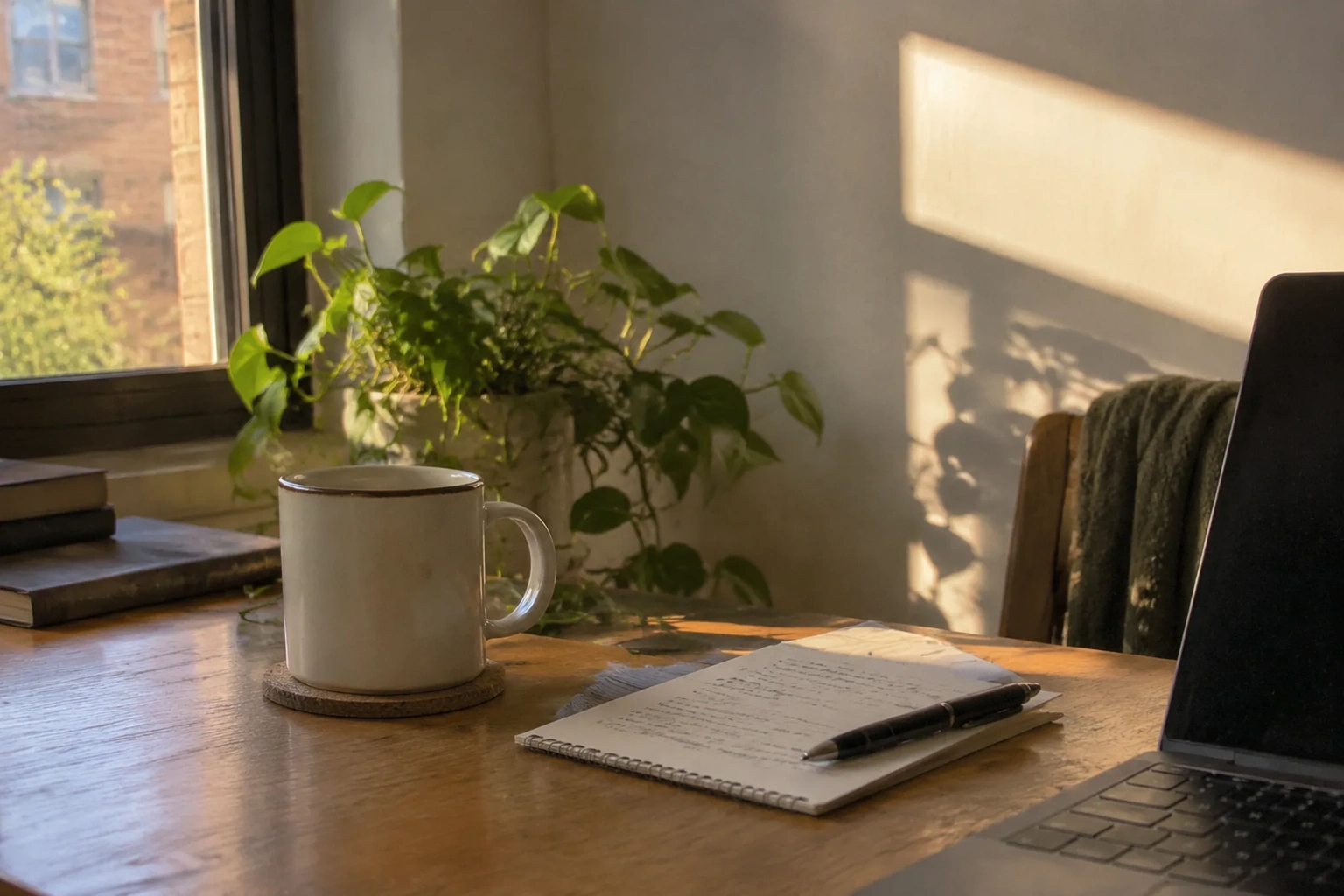
The kettle boils in four minutes. That is long enough to stand at the window and do nothing at all, which is the smallest and most reliable form of care there is.





















