







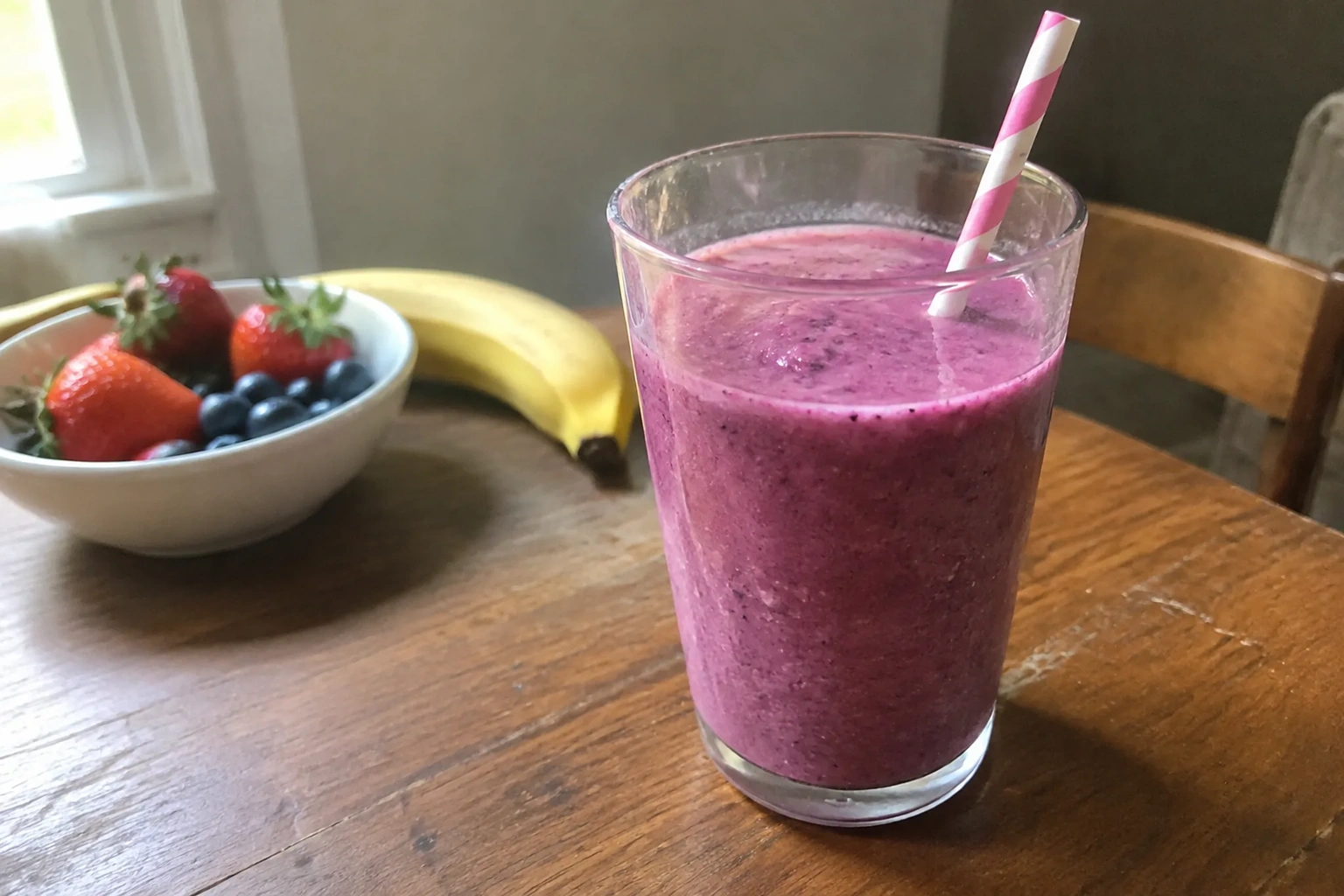
Blending a smoothie without added sugar is easy. Blending one that a person actually wants to finish is a harder problem, and most recipe collections solve it by cheating: they lean on banana, dates, or a long pour of apple juice and call the result "no added sugar" because none of those ingredients arrive in a bag labeled sugar. That is technically true and practically useless. A date is roughly two-thirds sugar by weight. The body does not read the ingredient list.
The interesting work sits in the gap between sweet and flavorful. A smoothie can taste sweet without any added sugar, and it can taste good without tasting sweet at all. The second path is the one worth taking, because it holds up across a whole summer instead of three days.
What "No Added Sugar" Actually Covers
The phrase has a narrow legal meaning in most labeling systems: no sucrose, no honey, no agave, no maple syrup, no concentrated fruit juice added as a sweetener. Fruit blended whole does not count as added sugar. Neither does the sugar naturally present in yogurt or milk.
That leaves a wide field. A smoothie built on frozen mango, a spoon of full-fat yogurt, and a splash of milk contains no added sugar and will taste genuinely sweet, because mango is a very sweet fruit. The same smoothie with a tablespoon of honey stirred in would taste only marginally sweeter. The honey is not doing much work. This matters because people tend to overestimate how much sweetness is missing and underestimate how much texture and acidity are missing.
Most disappointing sugar-free smoothies fail on texture first and flavor second. They are thin, or gritty, or they separate in the glass within four minutes. Fix the body and the sweetness question shrinks.
The Banana Problem
Bananas are the default smoothie base for a reason. They bring potassium, they bring pectin, and a frozen banana blended into anything produces a texture close to soft-serve. They also bring a flavor that dominates. Put half a banana into a smoothie with spinach, blueberries, and ginger, and the result tastes like banana with a green tint.
There is a second issue. Banana sweetness climbs as the fruit ripens, and a smoothie made with a spotted, fully ripe banana lands close to a dessert. That is fine if dessert is the goal. For a smoothie meant to carry vegetables, herbs, or tart fruit, a less ripe banana (yellow with a little green at the stem) keeps the body without flattening everything else.
For anyone who wants the texture without the flavor, frozen cauliflower rice is the honest substitute. A half cup of it blended with the rest of the ingredients adds creaminess and almost nothing else. It sounds like a health-food compromise. It works.
Fat Is the Missing Ingredient in Most Bad Smoothies
A smoothie made from fruit and water tastes like fruit and water. The mouthfeel is thin and the flavor reads as sharp, because sweetness without fat has nothing to soften it. A spoon of something fatty changes the entire drink.
Full-fat Greek yogurt is the simplest route, and a quarter cup is enough. Coconut milk, the canned kind, brings richness and a flavor that pairs well with mango, pineapple, and lime. A tablespoon of almond butter or tahini does the same job with a nutty edge. Even a few cashews soaked overnight and blended in will do it.
The fat also slows the whole thing down. A smoothie built purely on fruit sugar hits the bloodstream fast and leaves a person hungry an hour later. Fat and protein stretch that window. This is not a diet claim; it is the difference between a drink that functions as breakfast and one that functions as a snack that failed to hold.
Acid and Salt Do More Than Sweetness Ever Will
A flat smoothie usually lacks acid, not sugar. A squeeze of lemon or lime, roughly a teaspoon, brightens fruit flavors the way it does in a salad dressing. Without it, a mango smoothie tastes heavy and slightly dull. With it, the same drink tastes like mango.
Salt works the same way at a smaller scale. A pinch of fine salt in a smoothie with greens or nut butter rounds out bitterness. It is the difference between a green smoothie that tastes like a lawn and one that tastes like a drink. Nobody will identify the salt. They will just notice the smoothie is better.
Spices belong in this category too. Cinnamon, cardamom, fresh ginger, a scrape of vanilla bean or a few drops of vanilla extract: each one adds a layer that the tongue reads as complexity, and complexity reads as satisfying in a way that raw sweetness does not. A blueberry smoothie with a quarter teaspoon of cardamom tastes finished. Without it, it tastes like blended blueberries.
Building a Smoothie Around Vegetables Instead of Fruit
The most reliable no-added-sugar smoothies treat fruit as a seasoning rather than a base. Start with a vegetable that blends smooth and mild: cooked and cooled zucchini, steamed and frozen butternut squash, spinach, cucumber, or the cauliflower mentioned earlier. Add a small amount of fruit for sweetness, maybe a quarter cup of frozen berries or half a peach.
The proportions matter. Roughly two parts vegetable to one part fruit keeps the drink from tasting like a dessert, and the vegetable base provides volume without the sugar load. A cup of frozen zucchini and half a cup of frozen strawberries, blended with yogurt and a squeeze of lemon, produces something pale pink and thick that tastes like strawberries and costs almost nothing in sugar terms.
Cooked vegetables blend better than raw ones in most cases. Raw zucchini leaves a faintly bitter edge. Steamed and frozen, it disappears entirely. The same is true of pumpkin and sweet potato, both of which bring natural sweetness and body without a heavy sugar load.
Three Combinations That Work Without Any Sweetener
The first is cucumber, avocado, lime, and a small handful of mint, blended with cold water and a pinch of salt. It tastes like a drink served at a spa, in the good way. A quarter of an avocado is enough for two servings; more than that and the texture turns to pudding.
The second is frozen mango, a quarter cup of full-fat coconut milk, fresh ginger, and a squeeze of lime. Mango carries enough natural sugar that nothing else is needed. The coconut milk and ginger keep it from tasting like baby food. This one is close to a dessert and is honest about it.
The third is frozen blueberries, spinach, plain Greek yogurt, and a tablespoon of almond butter, thinned with milk. The yogurt and almond butter handle the body, the blueberries handle the flavor, and the spinach disappears entirely behind both. It is the least exciting of the three and the one most likely to become a weekday habit.
The Temperature Rule That Nobody Follows
Frozen fruit is not a shortcut. It is a structural ingredient. A smoothie made with fresh fruit and ice tastes watered down within minutes, because the ice melts and dilutes everything. Frozen fruit melts into the drink instead of thinning it, and the texture stays thick for the ten minutes it takes to finish the glass.
That means the freezer is doing more work than the blender in most good smoothies. A bag of frozen mango, a bag of frozen berries, and a bag of frozen cauliflower rice cover most of the combinations above. The fresh ingredients are the yogurt, the citrus, the ginger, and the nut butter, all of which keep for a week or more.
One more thing about temperature: a smoothie blended with room-temperature liquid and frozen fruit comes out colder than one blended with ice and cold liquid, because the fruit is colder than ice water. It also holds its texture longer. The difference is small and noticeable.
The Case Against Reaching for a Sweetener at All
There is a moment in making a no-sugar smoothie when the blender stops and the drink tastes flat, and the instinct is to add a date or a spoon of honey. That instinct is usually wrong, and the fix is usually acid, salt, or fat rather than sugar.
Sweetness is the easiest flavor to add and the least interesting one to taste. A smoothie that is only sweet has nowhere to go. A smoothie with acid, salt, fat, and spice has layers, and layers are what make a drink worth making twice.
The real test is whether the drink survives the third day. A smoothie built on a date and a banana tastes good once and then starts to feel like a chore. A smoothie built on zucchini, yogurt, lime, and mint tastes good on Monday and still tastes good on Thursday, because nothing in it is trying to be a dessert. That is the version worth keeping in rotation.





















