







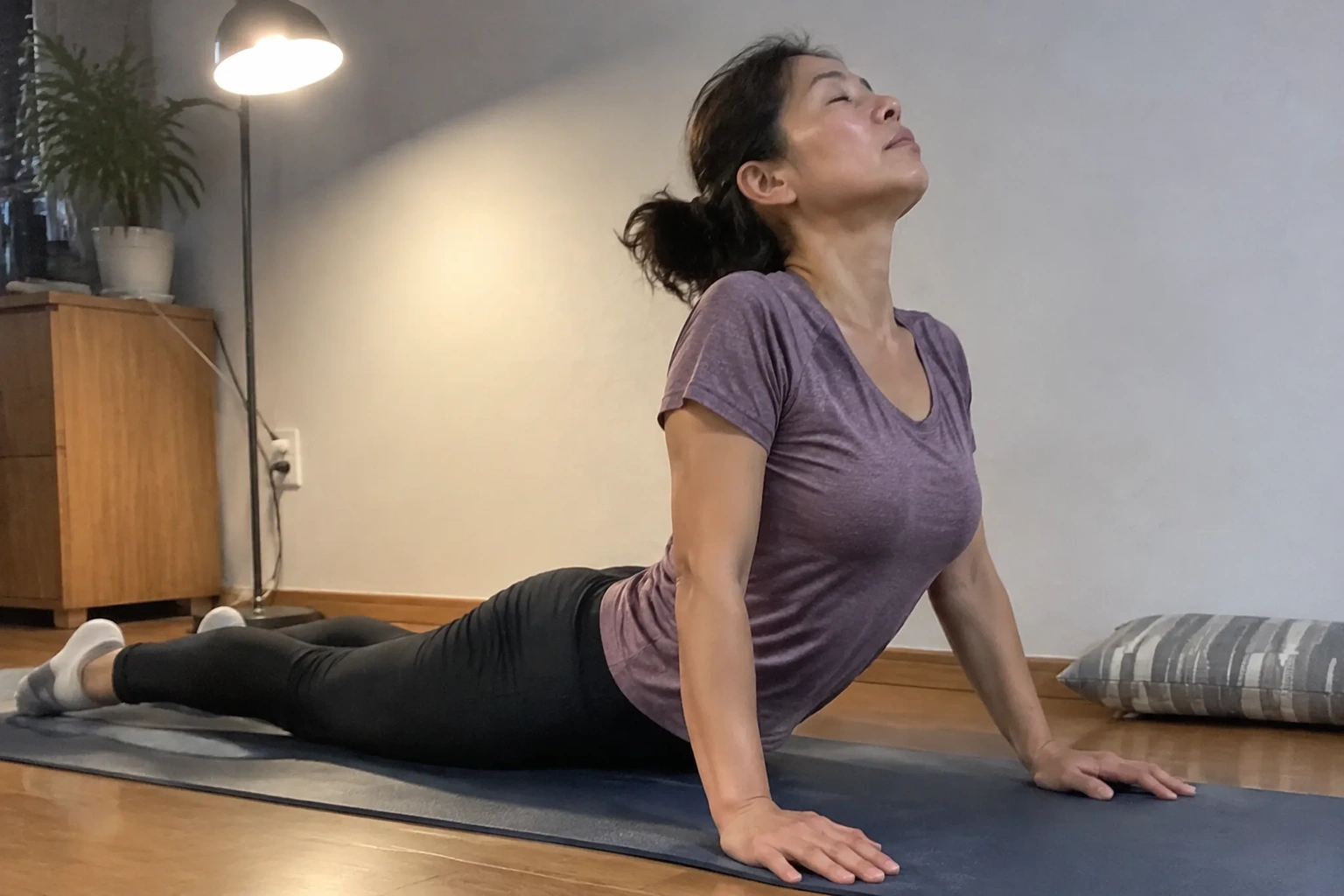
Lower back tension has a schedule. It arrives around the second hour of desk work, announces itself as a dull band above the belt line, and then negotiates: stand up and it eases, sit back down and it returns within twenty minutes. By evening the whole lumbar region feels like a clenched fist someone forgot to unclench. Stretching helps, and the evidence for gentle movement as a way to manage ordinary muscular tension is reasonable, though anyone selling a single magic pose is selling something else.
The trouble with most stretching advice is that it treats the back as a standalone object. The lower back is a junction box. Hip flexors pull on it from the front, glutes and hamstrings tug from below, the thoracic spine above it either rotates freely or doesn't, and the deep abdominal wall provides whatever bracing exists. A stretch that ignores all of that is a stretch aimed at a symptom.
What follows is a sequence built around that junction. Most positions hold for thirty to forty-five seconds, breathing stays slow, and nothing should produce sharp pain or numbness down a leg. If it does, that is a conversation for a clinician, not a column.
The morning hip flexor release before the first email
Half-kneeling at the edge of a rug, one knee down and the other foot planted forward, the pelvis tucks slightly under and the whole body shifts forward an inch or two until a stretch lands at the front of the rear hip. That is the psoas and the surrounding hip flexors, the muscles that spend all day shortened by sitting and then pull the lumbar spine into an exaggerated curve.
Most people rush this one. The pelvis has to stay tucked; if the lower back arches to chase the stretch, the hip flexor never lengthens and the lumbar spine absorbs the load instead. Thirty seconds per side, done before the laptop opens, sets a different tone for the day than thirty seconds done at 4 p.m. out of desperation.
Cat-cow as a diagnostic, not a workout
On hands and knees, the spine rounds slowly toward the ceiling, then drops toward the floor. The movement is small and unhurried, and its real value is informational. Somewhere in that arc a person learns which segments move easily and which feel stuck, whether the mid-back rotates or the whole motion happens at the neck, and whether breathing deepens the movement or interrupts it.
Ten slow rounds take under a minute. The opinion here is that cat-cow earns its reputation less as a stretch than as a warm-up that tells the nervous system the spine is safe to move. Tension often has a guarding component, and a spine that has been told to hold still for six hours needs permission before it needs length.
The supine twist that most people do too aggressively
Lying on the back, knees bent, both knees fall to one side while the shoulders stay planted. The stretch shows up in the outer hip and the side of the lower back. It should feel like a slow pour, not a wrench.
The common mistake is chasing the floor with the knees. If the top shoulder lifts or the lower back twists sharply, the pose has gone past useful. A folded pillow under the knees, or letting the knees rest only halfway over, keeps it honest. Forty-five seconds per side, with the exhale doing more of the work than the muscles.
Why the glutes get blamed for the wrong thing
Figure-four stretch, done on the back: one ankle crosses over the opposite thigh, the legs lift, and a hand reaches through to pull the standing thigh toward the chest. The sensation is in the buttock, sometimes sharply so, and this is where a lot of back-tension advice goes wrong.
Deep glute tightness is often a symptom rather than a cause. If the glute feels relentlessly tight no matter how much it is stretched, the more useful question is whether it is being asked to do too much work because the hip flexors and deep core are not contributing. Stretching a muscle that is overworking can feel good for an hour and change nothing over a month. The figure-four is worth doing, gently, but it is not the whole story.
The thoracic rotation that frees the lumbar spine from doing too much
Seated in a chair, arms crossed over the chest, the torso rotates slowly to one side and then the other. The pelvis stays square, which is the hard part; the movement has to come from the mid-back. A person who cannot rotate through the thoracic spine will rotate through the lower back instead, and the lower back was not built for that volume of twisting.
Eight to ten rotations per side, done once in the afternoon, is a small intervention with an outsized effect for anyone who spends the day reaching for a mouse with one hand while the ribcage stays locked forward. The mid-back is the forgotten region in most back-tension routines, and it deserves better.
Child's pose with a side reach for the quadratus lumborum
From hands and knees, the hips shift back toward the heels, the arms walk forward, and then both hands walk to one side. The stretch climbs up the side of the torso and lands in the deep muscle that runs from the top of the pelvis to the lowest rib. This is the muscle that complains after a day of standing with weight shifted onto one leg, or carrying a bag on one shoulder.
The side reach matters more than the forward reach. Most people do child's pose symmetrically and wonder why the lower back still feels lopsided. Thirty seconds per side, with the forehead resting on a cushion and the breath directed into the ribs on the stretched side.
Standing extension at the kitchen counter
Hands on the counter edge, feet hip-width apart, hips press back and the chest drops toward the floor. The spine extends gently, the hip flexors lengthen, and the whole front of the body opens. It is the closest thing to a reset available in a kitchen, which is where many people actually have thirty seconds to spare.
The counter height matters. Too low and the shoulders round forward; too high and the stretch disappears into the arms. A surface around hip height, or slightly above, lets the spine do the work. Twenty to thirty seconds, once or twice, whenever the day has been mostly seated.
The hamstring stretch that has to stay honest
Lying on the back, one leg lifts and a towel or strap loops around the foot, the leg straightens toward the ceiling until a stretch lands behind the thigh. Tight hamstrings tug on the pelvis and can flatten the natural lumbar curve, which is one reason a stiff posterior chain shows up as lower back complaint.
The honesty test: the lower back stays flat on the floor throughout. If it lifts, the leg has gone too far and the stretch is being borrowed from the lumbar spine. Thirty seconds per side is plenty; hamstrings respond to frequency more than duration.
Breathing that changes the tone of the whole sequence
None of these stretches work well with a held breath. The diaphragm attaches to the lumbar spine through the psoas and the connective tissue around it, and a shallow chest breath keeps the whole region braced. A slow nasal inhale that widens the lower ribs, followed by a longer exhale, softens the guarding that makes tight tissue feel tighter than it is.
This is not mysticism. It is mechanics. A person holding tension in the lower back is usually holding it in the breath too, and the two release together or not at all.
Timing, frequency, and the case against heroic stretching sessions
A forty-minute stretch routine done once a week will do less than four minutes done daily, and this is the real argument against the elaborate sequences found in most videos. The spine and hips respond to small, frequent inputs. Two hip flexor stretches before coffee, a cat-cow between meetings, a supine twist before bed, and the whole week has more movement in it than one ambitious Sunday session.
The other case against heroic sessions: they tend to be followed by nothing. The person feels virtuous after forty minutes of stretching and then sits for eight hours the next day. Cumulative small movement beats occasional large movement for ordinary back tension, and the research on this is not controversial even if the marketing around stretching pretends otherwise.
When a stretch is the wrong answer entirely
Sharp pain, numbness, tingling down a leg, or tension that wakes a person at night are not stretching problems. Those symptoms point toward nerve involvement or something structural, and stretching a nerve irritated by a disc or a narrowed space can make it worse. The same is true of any stretch that produces pain radiating below the knee. A clinician should see those cases before a yoga mat does.
For ordinary muscular tension, the kind that builds through a desk day and settles by morning, the stretches above are reasonable and low-risk. They are not a cure for anything structural, and they are not a substitute for the walking, lifting, and general movement that keep a spine happy over decades. They are a modest toolkit for the specific complaint of a lower back that has been held in one position too long.
The floor by the bed, a folded blanket, and ninety seconds before sleep: that is where most of this actually gets done. The person who stretches is not the one with the elaborate routine. It is the one who leaves a towel on the bedroom rug as a reminder and uses it for the hamstring stretch while the kettle boils in the morning, thirty seconds a side, before the day has a chance to tighten anything back up.





















