







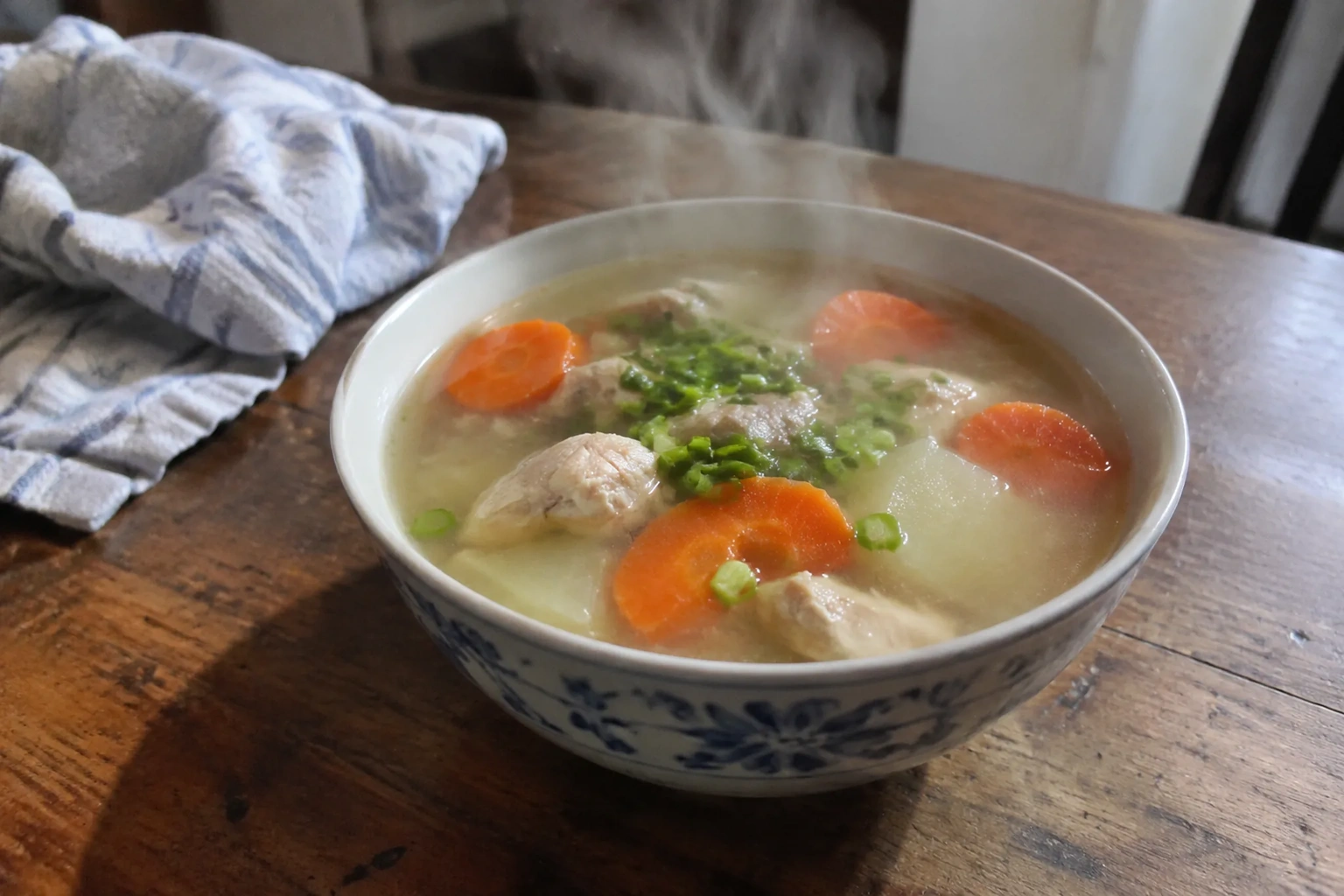
On the coldest weeks, the body asks for soup before the mind has finished deciding. It is a physical pull, the same one that makes hands reach for a heavy mug, and it explains why the pot on the back burner becomes the most-used appliance in the house between December and March. A good soup does the work of a blanket: it slows a person down, holds warmth against the ribs, and makes an ordinary evening feel tended.
But "soup" covers too much ground. There is the thin, restorative broth a person sips after a long day, and there is the thick, spoon-standing kind that eats like a meal and leaves the kitchen smelling of onions and time. Both belong to the cold-weather kitchen. They are simply different comforts.
The real question for a chilly week is what a pot can deliver without demanding a whole afternoon of stirring. Most weeknights allow maybe forty minutes, one cutting board, and a cook who is already tired. The soups that answer that call share a set of practical virtues: they come together in one pot, they forgive substitutions, and they taste better the next day, which means Tuesday's batch is also Wednesday's dinner.
The case for starting with onion and fat
Nearly every soup that feels substantial begins the same way, and it is worth treating the step with more care than recipes usually grant it. Onions go into a wide pot with a generous film of fat, whether butter, olive oil, or a mix, and they stay over medium heat until the edges turn gold and the volume drops by half. This takes ten to fifteen minutes of occasional stirring, and it is the single most valuable ten minutes in the whole process.
What happens in that pot is the difference between a soup that tastes of vegetables in water and one that tastes built. The sugars in the onion brown, the fat carries that sweetness through the whole batch, and the final bowl reads as rich even when no cream has gone near it. A cook who rushes this step, who sweats the onions for three minutes until they go translucent and then adds stock, will spend the rest of the recipe trying to recover something that cannot be added at the end.
Garlic goes in late, only for the last thirty seconds, because it burns faster than onion browns and a bitter edge is hard to hide. A pinch of salt at the start helps draw out moisture. Beyond that, the pan can hold whatever the week offers: a grated carrot, a spoon of tomato paste cooked until it darkens, a bay leaf, a few peppercorns.
Lentil and sausage soup, the weeknight workhorse
If one pot had to cover an entire cold month, this is the one. Brown lentils, sold in most supermarkets for less than a bag of chips, cook in about half an hour with no soaking. A single link of smoked sausage, diced small, gives the pot a smoky backbone that makes the batch taste far more elaborate than it is. The sausage does double duty: its fat starts the onions, and its meat stays in the bowl for texture.
The method is straightforward. Brown the diced sausage in the pot, lift it out, and let the onions take over in the rendered fat. Add a chopped carrot and a stalk of celery if they are around, then the lentils, a can of tomatoes, and enough stock to cover everything by an inch. Simmer until the lentils are tender but still hold their shape, roughly twenty-five minutes. Return the sausage, taste for salt, and finish with a splash of vinegar.
That last splash matters more than its size suggests. Lentils, like most legumes, can read as flat and earthy, and a teaspoon of red wine vinegar or lemon juice at the end lifts the whole pot without adding any taste a person could name. The soup should be served with something for dipping, because a thick lentil soup can feel heavy by the third spoonful and a torn piece of baguette solves that.
It also improves overnight. The lentils drink up the broth, so the next day's version is thicker and more concentrated, which is a virtue in a soup this sturdy. A little water or stock loosens it before reheating.
Chicken and rice, and the leftover bird
A roast chicken on Sunday becomes a week of soup on Monday, and the economics are hard to beat. The carcass, covered with water and simmered for an hour with an onion and a carrot, yields a stock that tastes of the actual bird. This is not the same substance as the cubes, which are mostly salt. The difference shows up in the bowl as a rounded, savory depth that no seasoning can imitate.
The soup itself is almost too simple to write down. Onions and carrots softened in butter, the strained stock, a handful of rice, and the shredded leftover meat added near the end. A squeeze of lemon and a fistful of chopped parsley finish it. The rice needs to be cooked in the broth rather than added already cooked, because that is how it releases its starch and gives the soup a slight body.
Watch the rice, though. It keeps drinking liquid as the soup sits, and by the following afternoon a pot that was brothy at dinner can turn into something closer to a risotto. Cook the rice separately if the plan is to eat leftovers for several days, or accept the thickening as a feature.
Miso broth for the nights that leave no patience
Some evenings allow no browning, no simmering, no waiting. For those, a lighter broth built in ten minutes earns its place. A pot of water or dashi, a spoon of white miso whisked in off the heat, thin slices of mushroom, cubed tofu, and a handful of greens is a complete bowl. The miso should never boil, or it loses the fresh, fermented edge that makes it worth using.
This is the soup that suits the hours after a long commute, when the body wants warmth more than it wants a meal. It is also the easiest to vary: a soft-boiled egg, a spoon of chili oil, a scatter of scallions, a few dumplings from the freezer. The broth stays light and clean, and a person can eat it without feeling slowed down.
The one rule is the miso itself. Buy a tub of it rather than the powdered packets, which are mostly salt and dehydrated vegetables. A single tub lasts months in the refrigerator and turns a plain pot of water into something with real depth in under a minute.
Potato and leek, and the texture question
Potato and leek soup has a reputation as a fussy, restaurant dish, but the home version is one of the most forgiving soups in the repertoire. Leeks, sliced and washed carefully, soften in butter with a pinch of salt, then potatoes and stock go in and simmer until the potatoes fall apart. A blender or an immersion stick turns it smooth. A splash of cream or milk at the end is optional but welcome.
The washing step is where most home cooks go wrong. Leeks hold grit between their layers, and a quick rinse under the tap leaves it there. The reliable method is to slice the leek first, then swish the slices in a bowl of cold water and lift them out, leaving the dirt to settle at the bottom. Skipping this step means a soup with grit at the bottom of every bowl.
A note on texture, since it divides people. A fully smooth soup is elegant but can feel thin, while a soup left slightly chunky is more rustic and, to a certain palate, more satisfying. The best answer is to blend only part of the pot and leave the rest, so each spoonful has both creaminess and a little bite. This takes no extra equipment and no extra time, and it makes the soup taste more deliberate than a fully puréed version.
Stock, the argument worth having
There are two kinds of cooks in the world: those who keep a bag of vegetable scraps in the freezer for stock, and those who buy cartons. Both are reasonable. Cartons have improved enormously, and a good low-sodium chicken or vegetable stock is a fine foundation for a weeknight soup. What a person should avoid is the bouillon cube, which is mostly salt and often carries a metallic aftertaste that no amount of fresh herbs can bury.
A homemade stock, on the other hand, is a way to turn trash into something genuinely good. Onion skins, carrot peels, mushroom stems, celery leaves, and a few peppercorns, covered with water and simmered for an hour, make a stock that is better than anything sold in a box and costs nothing. It freezes in portions and turns a random Tuesday into a soup night.
The one caution is the vegetables themselves. Cabbage, broccoli, and other brassicas turn a stock bitter and sulfurous when boiled for a long time, so they should be left out of the scrap bag. The same goes for potato peels, which cloud the stock and add a muddy taste. Stick to onions, carrots, celery, mushrooms, and herbs.
The freezer is the real cold-weather appliance
Every soup mentioned here freezes well, with one exception: any soup containing potatoes or rice should be eaten within a few days, because those starches turn grainy in the freezer. Lentil, chicken, miso, and puréed vegetable soups all freeze cleanly in quart containers, and a person who doubles a batch on Sunday has dinner waiting three weeks later when the forecast turns nasty.
The habit worth building is a simple one. When the pot comes off the stove, ladle a portion into a container, label it with a piece of tape, and put it in the freezer before anyone sits down to eat. The batch that looks like too much on Monday becomes the reason a person is not ordering takeout on the coldest night of February.
There is something quietly satisfying about a freezer full of soup in January. It is not glamorous, and it will not impress anyone at a dinner party, but on the night when the wind is loud against the windows and the walk home has left hands numb, the knowledge that a container of lentil and sausage is waiting, already made, already good, is its own kind of blanket.





















