







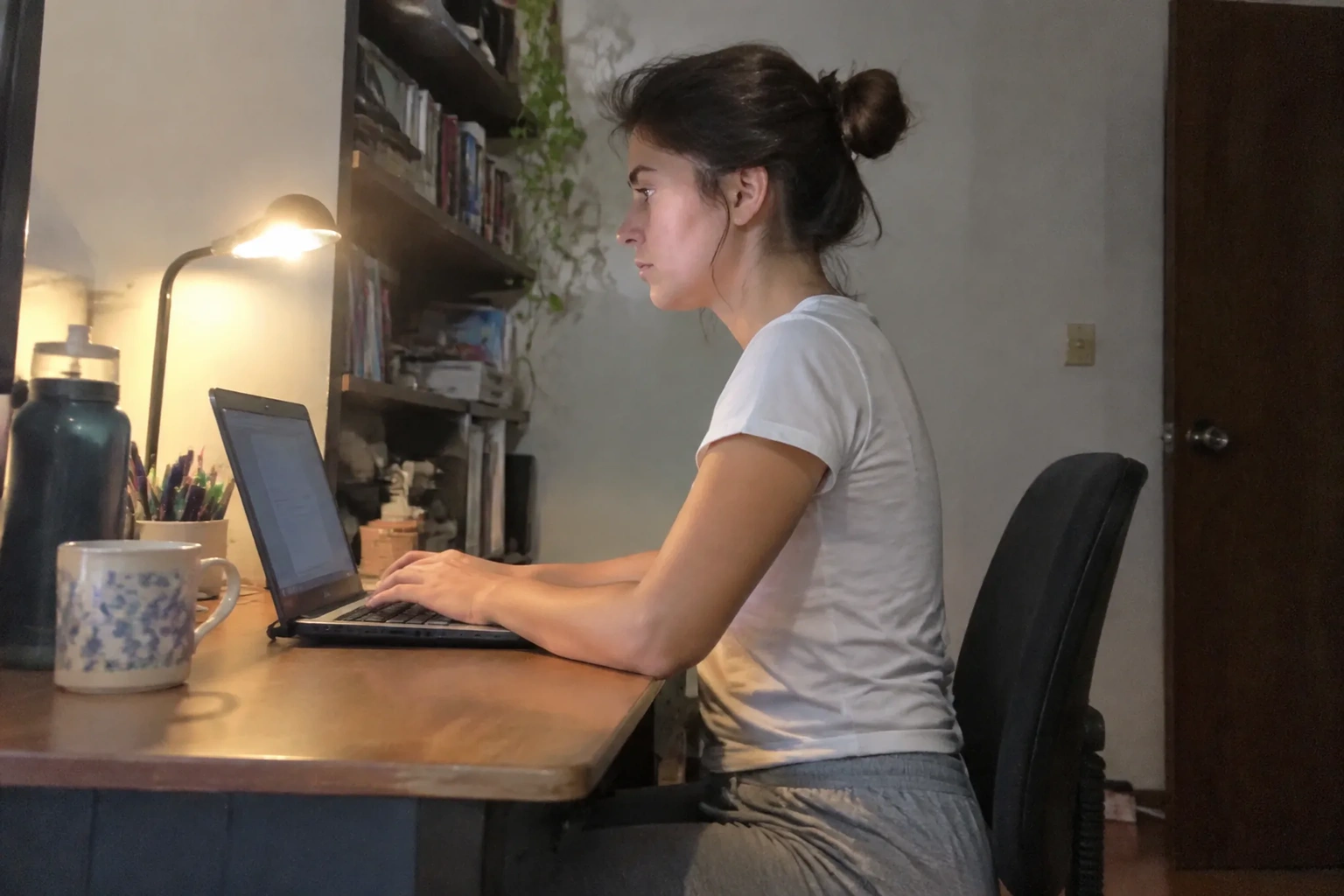
Somewhere between the fourth and fifth hour at a desk, the body begins to fold. The head drifts forward, the shoulders round toward the screen, and the lower back quietly gives up its curve. Nobody decides to slouch. The chair, the keyboard height, and the angle of the monitor make the decision on their own, and the body complies.
Posture at home and at a desk is mostly a story about furniture and habit, and almost none of the popular advice about "standing tall" addresses either one. The usual instruction is to pull the shoulders back and lift the chest. That instruction lasts about ninety seconds before the muscles tire and the spine returns to wherever the chair allows it to go.
The fix lives in the setup, and in a handful of small movements repeated through the day. What follows is a walk through a desk, room by room, surface by surface, with the specific adjustments that change where the body actually settles.
The chair is the first thing to examine, and usually the last thing anyone touches
A chair with a seat pan that slopes backward will roll the pelvis into a slump no amount of willpower can correct. The pelvis is the foundation. When it tilts back, the lower spine flattens, the ribcage drops, and the head has to jut forward to keep the eyes level. Every part of the collapse traces back to that first tilt.
A seat that slopes slightly forward, or at least sits flat, lets the pelvis stay upright and the natural curve of the lower back hold itself. Many office chairs have a seat tilt adjustment that nobody has ever turned. It is usually a lever or a knob under the front edge of the seat, and turning it five degrees forward changes more about a working day than a year of posture reminders.
Seat depth matters just as much. A seat pan that presses into the back of the knees forces the sitter to slide forward, which rounds the whole spine. The rule is roughly two fingers of clearance between the back of the knee and the edge of the seat. If there is none, the chair is too deep, and no cushion arrangement will fix it cleanly.
The screen height nobody measures, and the neck that pays for it
The top third of a monitor should sit roughly at eye level. This is the single most repeated piece of ergonomic advice and the one most widely ignored, partly because laptops make it impossible. A laptop on a desk puts the screen about eight inches below where the eyes rest, and the neck compensates by bending forward for entire afternoons.
A laptop stand solves the screen and creates a new problem: the keyboard rises with it, and the wrists end up cocked backward at a sharp angle. The clean answer is a stand plus an external keyboard, which costs less than a single visit to a physiotherapist and takes about ten minutes to set up. The desk surface stays at elbow height. The screen comes up to the eyes. The hands float level over the keys.
For anyone who refuses the external keyboard, the compromise is to raise the laptop on a stack of books and tilt the screen back slightly, accepting a mild downward gaze. A neck bent twenty degrees forward for hours is a different animal from one bent forty. Small differences in angle compound over a working life, and the neck is unforgiving about the arithmetic.
Feet flat, or the entire chain above them unravels
Dangling feet are a common and quiet cause of slouching. When the feet cannot reach the floor, the body slides forward on the seat to find stability, and the spine pays. A footrest, a stack of hardback books, or a box under the desk restores the missing contact and lets the pelvis settle back where it belongs.
The feet should rest flat, roughly hip width apart, with the knees at about ninety degrees or slightly more. Crossing the ankles for a few minutes is fine. Crossing the ankles for an hour rotates the pelvis and loads one hip, and the lower back registers the asymmetry by the end of the day.
The standing desk earns its keep only if the standing part is respected
A standing desk raised to the wrong height is worse than a chair. Too high, and the shoulders hike toward the ears and the wrists bend upward to reach the keyboard. Too low, and the torso folds forward over the work. The top of the desk should land just below the elbows when the arms hang relaxed at the sides, roughly at the bottom of the ribcage.
Standing all day has its own costs. The lower back tires, the feet ache, and the body starts shifting weight from one hip to the other in a slow lean that undoes the benefit. The useful pattern is alternation: twenty to thirty minutes standing, then sitting, then standing again. The change itself does more for the spine than either position held indefinitely.
A standing mat with some give underfoot helps, though a folded towel does nearly the same job. The point is to keep the feet from going numb and the knees from locking straight, which is the standing equivalent of slouching.
The phone in the hand is a posture problem disguised as a convenience
The average person checks a phone dozens of times a day, and each check involves a small forward bend of the neck. Held at chest height, the phone pulls the head down and the shoulders in. Held near eye level, the neck stays closer to neutral. The difference between the two habits, multiplied across a day, is the difference between a stiff neck at 6 p.m. and a comfortable one.
At home, the same principle applies to the sofa. A laptop balanced on the knees, or a tablet propped on a cushion, drops the head and rounds the upper back. A lap desk, or simply a firm cushion under the device, lifts the screen and lets the spine stay closer to upright. The sofa is where posture goes to die, and a small prop is often all that stands between a relaxed evening and a sore morning.
Movement resets what stillness breaks
No setup, however careful, survives four hours of stillness. The spine likes variety more than it likes any single "correct" position. A person who sits upright and motionless for three hours is not in better shape than one who slouches and shifts every twenty minutes. The tissues that support posture need blood flow, and blood flow needs movement.
This is why the micro-break matters more than the perfect chair. Standing up once an hour, rolling the shoulders back a few times, and walking to the kitchen for water resets the muscles that have been holding a fixed position. A timer, a phone reminder, or simply the habit of standing during every phone call all work. The specific trigger matters less than having one.
A short sequence done standing, maybe ninety seconds total, covers most of what a desk does to a body. Roll the shoulders back and down. Lift the chest and let the arms fall behind the hips. Tuck the chin slightly and lengthen the back of the neck. Reach the arms overhead and take one slow breath. That is enough. It does not need to be a workout, and treating it as one is the fastest way to stop doing it.
The mirror test at the end of the day
A quick check near a mirror, or a phone camera propped against a mug, shows what the body has been doing. Standing sideways, the ear should sit roughly over the shoulder, the shoulder over the hip, and the hip over the ankle. Most people find the ear well forward of the shoulder and the pelvis tucked under. That gap is the day's accumulated slouch, and it usually eases within a few minutes of standing tall and breathing.
The mirror also reveals which side of the body carries more weight. A hip hiked higher than the other, a shoulder dropped, a head tilted slightly off center: these are the small asymmetries that come from a bag carried on one side, a wallet in a back pocket, or a monitor positioned off to one corner of the desk. Correcting them is usually a matter of moving an object, not correcting the body.
What the body remembers at 9 p.m.
Posture is not a pose held for a photograph. It is the shape a body settles into when the attention is somewhere else, and that shape is set by the surfaces around it. A chair that tilts the pelvis forward, a screen at eye level, feet flat on the floor, a phone lifted to the face, and a stand-up break every hour: these are the levers. None of them require discipline. They require a screwdriver, a stack of books, and a timer.
The proof arrives on a Tuesday evening, when the shoulders are loose, the neck turns without a wince, and the lower back does not ache after a long day at the desk. That feeling is the result of a dozen small physical arrangements made earlier in the day, each one unremarkable on its own, adding up to a body that stands a little taller without being told to.





















