







Cardiologists have been telling patients to walk for decades, and the advice holds up. But somewhere in the last few years, a quieter recommendation started showing up in exam rooms and cardiac rehab clinics: lift something heavy, a few times a week, and the heart benefits in ways walking alone does not deliver. The science behind that shift is solid enough that major heart organizations now list resistance training alongside aerobic exercise in their guidance for adults. The practical question, for someone who has never touched a barbell or has not since high school, is where the first month actually goes.
The answer is less intimidating than the gym floor suggests. Strength training for heart health does not require a power rack, a trainer, or a program with a name. It requires a handful of movements, a load that can be controlled, and enough patience to let the cardiovascular payoff accumulate over months rather than sessions.
What Lifting Does to a Heart That Walking Does Not
Aerobic exercise mostly works the heart as a pump, pushing volume through the system and training the muscle to move more blood per beat. Resistance training applies a different kind of stress: it compresses blood vessels during a hard set, then releases them, and the repeated cycle appears to improve how well the vessel walls relax and stretch. That flexibility matters for blood pressure regulation. Over time, regular strength work tends to shave a few points off resting blood pressure and improve insulin sensitivity, both of which sit close to the center of long-term heart risk.
There is also the muscle itself. Skeletal muscle is a glucose sink; more of it means more places for blood sugar to go after a meal. Adults lose muscle mass steadily from midlife onward, and the loss quietly reshapes metabolic health. Lifting slows that decline. The heart does not benefit from bigger biceps directly, but it benefits from the machinery those biceps belong to.
The caveat that deserves stating plainly: heavy lifting produces sharp, temporary spikes in blood pressure during a set. For most people this is harmless and even part of the training effect. For someone with uncontrolled hypertension, a recent cardiac event, or an aortic aneurysm, the calculation changes, and a doctor should be involved before the first session. That conversation is worth having rather than skipping.
The Six Movements That Cover Almost Everything
A beginner program does not need variety. It needs repetition of a small number of patterns until they feel automatic. Six movements cover the major muscle groups and the major joints: a squat, a hip hinge, a push, a pull, a carry, and a core brace. Everything else is decoration.
The squat can start as a sit-to-stand from a dining chair. The hinge can start as a hip bridge on the floor or a light kettlebell deadlift. The push can be a wall push-up progressing to an incline push-up against a counter. The pull can be a resistance band row anchored to a door. The carry is a walk across the room holding a weight in each hand, posture tall. The core brace is a plank held for twenty seconds, or a dead bug on the floor if a plank bothers the lower back.
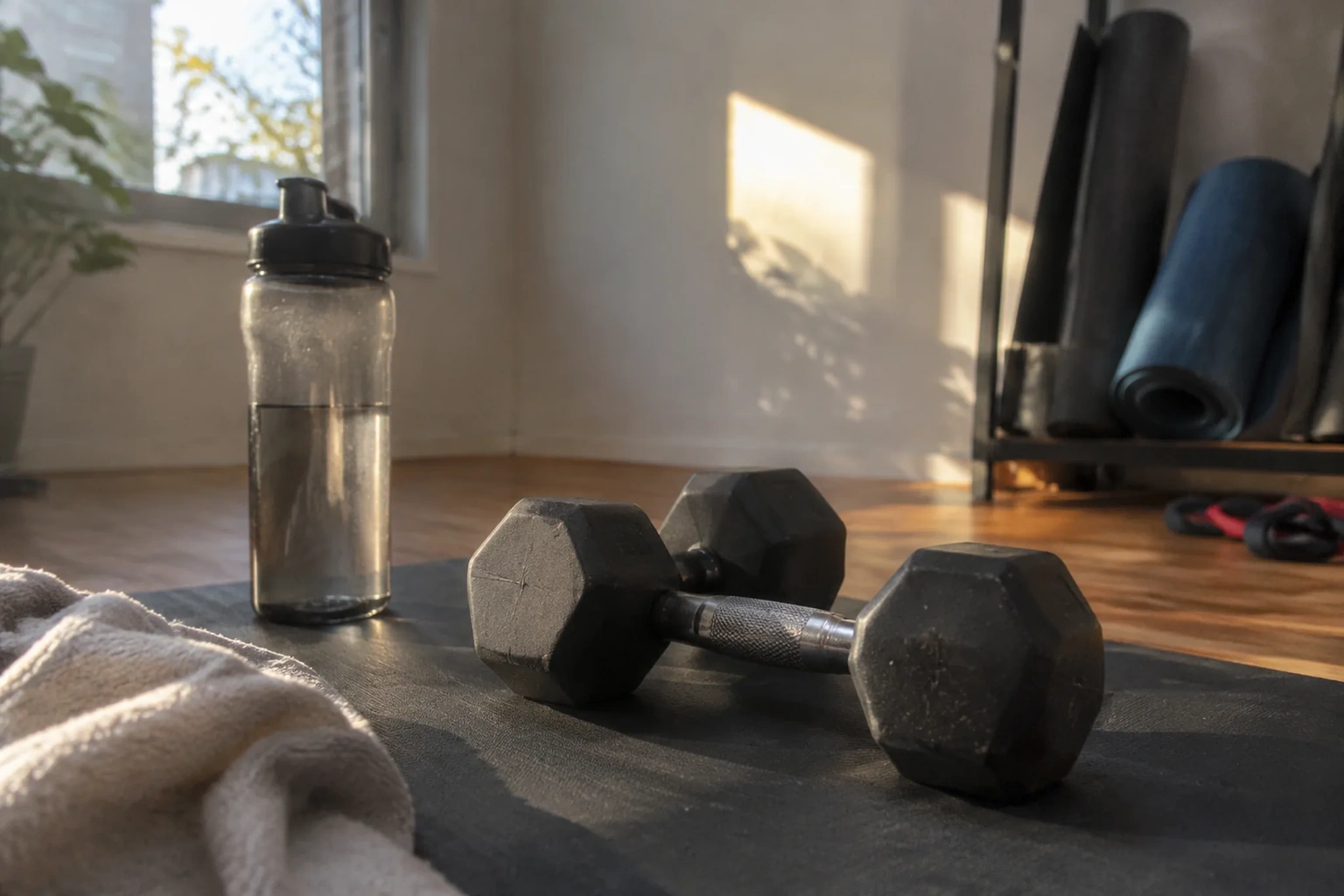
That is a full-body session. It takes twenty-five minutes at a conversational pace, and it can be done in a living room with a chair, a band, and a pair of dumbbells that a person can lift overhead eight times without straining.
Choosing a Starting Weight Without a Coach
The most common beginner error is choosing a weight that feels respectable rather than a weight that teaches the movement. A useful test: pick up the dumbbell, perform eight slow repetitions, and notice whether the last two required genuine effort while the first two felt almost too easy. If all eight felt the same, the weight is too light. If form broke down by rep five, it is too heavy.
The number on the dumbbell is irrelevant. A forty-year-old who has never trained may start a goblet squat with fifteen pounds and a row with ten. A former athlete returning after a decade off may start at double that and still be humbled by the third set. Starting too light costs a few weeks of progress. Starting too heavy costs a strained lower back and a month away from the gym, which is a far worse trade.
Two Sessions a Week Beats Four Sessions Abandoned
The heart adapts to consistency, not intensity. Two full-body sessions per week, spaced at least two days apart, produce most of the cardiovascular and metabolic benefit a beginner will see in the first six months. Three is fine for someone with the schedule and the recovery. Four is where most new lifters discover that their sleep, their joints, and their enthusiasm cannot yet support the load.
The sessions should be short. A beginner who spends forty-five minutes on the gym floor is usually resting too long between sets, which is a habit borrowed from advanced lifters who need the recovery. For heart health specifically, shorter rest periods (sixty to ninety seconds) keep the heart rate elevated through the session and add an aerobic component to the work. The result is a workout that trains the heart and the muscles at the same time, which is the whole point of combining the two modalities.
Breathing, Blood Pressure, and the Valsalva Trap
There is a technique lifters use on maximal attempts called the Valsalva maneuver: a hard breath held against a closed throat to brace the torso. It stabilizes the spine and it sends blood pressure briefly very high. Competitive powerlifters accept that trade for a single heavy rep. A beginner training for heart health has no reason to make it.
The alternative is simple exhale-on-effort breathing. Push the weight away and breathe out. Pull the weight toward the body and breathe out. The rhythm feels awkward for the first week and then becomes automatic. Blood pressure still rises during a set, as it should, but the spike stays within a range the cardiovascular system handles comfortably.
Anyone taking blood pressure medication should know that lifting can shift how the body responds to it, and a resting reading taken the morning after a session may look different from one taken on a rest day. That is worth mentioning to a doctor rather than self-adjusting a dose.
The Role of Walking on the Days Between
Strength training does not replace aerobic work, and a program that drops walking entirely misses half the benefit. The heart wants both: the volume of steady aerobic effort and the pressure challenge of resistance. A reasonable weekly structure pairs two lifting sessions with three or four brisk walks of thirty minutes, with at least one full rest day.
The walks do something else useful. They promote blood flow to muscles that are repairing after a lifting session, which reduces soreness and keeps the next session on schedule. A lifter who skips the walks tends to feel stiffer and more reluctant to return to the rack.
What Progress Looks Like in Month Three
The scale is a poor measure of early strength training progress, because muscle gained and fat lost can cancel each other out. A better set of markers: the number of push-ups performed against the counter before fatigue, the weight carried in each hand across the living room, the number of seconds a plank can be held with a flat back. Those numbers move in the first eight weeks for almost everyone who trains twice a week.
The cardiovascular markers move more slowly. A resting heart rate may drop two to five beats per minute over a few months. Blood pressure improvements tend to show up around the eight to twelve week mark. The subjective markers, the ones that matter most, arrive earlier: stairs feel shorter, grocery bags feel lighter, and the afternoon slump softens.
The First Session Is a Walk-Through, Not a Test
A person starting this week should treat the first session as a rehearsal. Perform each of the six movements for two sets of eight with a weight that feels almost embarrassingly light. Stop while there is still energy in reserve. Write down what was used, in a notebook or a phone, because the second session needs a reference point.
Then do it again two days later, adding a small amount of weight or a repetition to one movement, not all of them. The progression that builds a stronger heart over a year is unremarkable on any single day. It is a stack of small, boring, repeatable sessions, done in a living room or a gym or a garage, with a pair of dumbbells that gradually gets heavier and a heart that gradually gets harder to wind.





















