







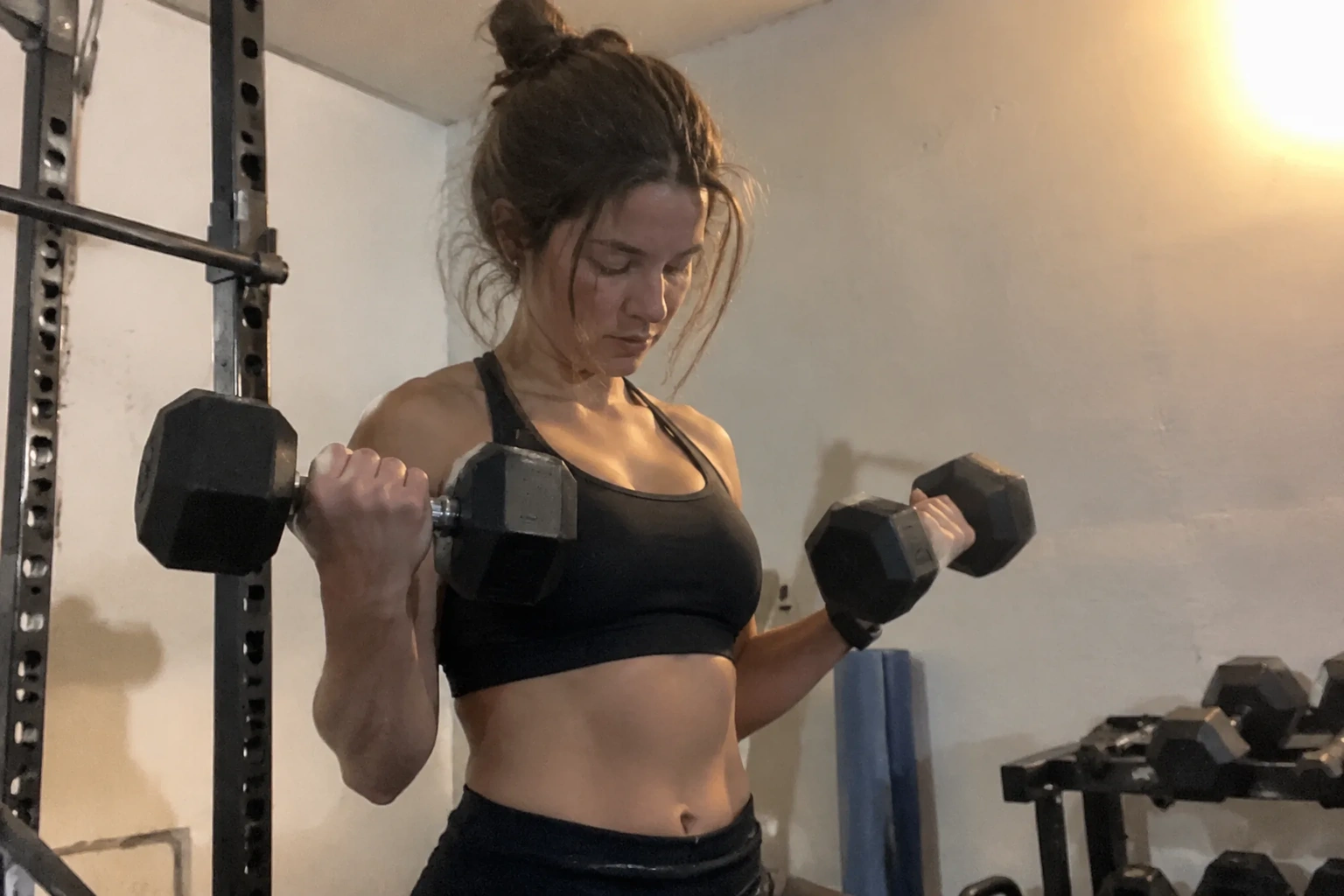
A woman walks into a gym, picks up a five-pound dumbbell, and is told by a trainer that lifting anything heavier will make her bulky. Nobody measures her body fat first. Nobody asks whether her goal is to climb stairs without gasping or to fit into an old pair of jeans. The dumbbell goes back on the rack, and the myth does its quiet work.
That scene repeats in thousands of gyms, in different costumes. The myths about women and strength training are not dead. They have simply gotten subtler, moving from locker-room whispers into the mouths of well-meaning friends and, occasionally, paid professionals. Most of them are wrong. A few are half-right in ways that matter. Sorting the two apart is worth an hour of anyone's attention.
The bulk myth has the mechanics backward
Heavy lifting does not turn a woman into a bodybuilder. The women who look like bodybuilders look that way because they train with extraordinary volume, eat with deliberate surplus, and in many cases use anabolic drugs. Muscle growth is a slow, stubborn process that fights against most attempts to spark it. A woman who lifts three times a week and eats normally will get stronger, denser, and slightly more defined. She will not wake up looking like a competitor on a magazine cover.
The physiology is not mysterious. Testosterone is the primary driver of rapid muscle hypertrophy, and women produce roughly a tenth to a fifteenth of what men do. That gap means the ceiling on natural muscle gain is lower and the pace is slower. A year of consistent heavy training might add a few pounds of lean mass to a woman's frame. Most of the visible change in the first six months is neural: the nervous system learns to recruit more fibers at once, so the same muscle does more work.
Five-pound dumbbells are, in this light, a kind of insult. They are light enough to do almost nothing for a person who has been carrying groceries and children and suitcases for years. The body adapts to what it is asked to do. Ask it to lift five pounds, and it stays exactly as it was.
Lifting light forever is its own trap
There is a particular gym ritual worth naming: the high-repetition, low-weight circuit, performed with pink dumbbells and a sense of virtue. It looks like work. It produces a sweat. It rarely produces strength. The weight is so light that the muscles are never asked to generate real force, and the body has no reason to rebuild itself.
Progressive overload is the principle that makes training work. The load has to increase over time, or the reps have to rise, or the sets have to add up, or the tempo has to slow. Without that progression, the body plateaus within weeks. A woman who has done the same 3-pound arm routine for two years is not training. She is rehearsing.
This is where the bulk myth becomes a trap rather than a simple error. Fear of getting too big keeps the weight light. Light weight produces no visible change. No visible change confirms the belief that women cannot build muscle, so the weight stays light. The loop closes and the dumbbell stays on the rack.
Cardio and weights are not rival religions
Another durable myth holds that a woman must choose: cardio for fat loss or weights for tone. The body does not organize itself into such tidy categories. Strength training builds and preserves muscle, which is metabolically expensive tissue and helps with body composition over the long run. Cardio improves the heart and lungs and burns calories during the session. Both are useful, and neither cancels the other.
The real conflict is one of scheduling, not physiology. A woman who runs forty miles a week and lifts twice may find that the running leaves her too depleted to lift heavy. A woman who lifts four times a week and does no cardio may find her conditioning slipping. The fix is to decide what matters most this season and arrange the week around it, not to swear off one mode entirely.
For most people, two or three strength sessions and a few moderate cardio sessions fit into a normal week without much drama. The order matters less than the consistency. Doing both badly beats doing one perfectly and the other never.
Soreness is a poor report card
The day after a hard session, the legs ache. The ache is treated as proof that the workout worked. When the ache fades, the workout is judged too easy. This is a bad way to measure anything. Delayed-onset muscle soreness is driven partly by novelty and partly by eccentric loading, the phase where the muscle lengthens under tension. A new exercise will produce soreness in a trained person. The same exercise, done heavier and better, may produce almost none.
Chasing soreness leads to erratic training. A woman who needs to feel wrecked after every session will keep switching exercises to chase the ache, and never get good at any of them. The better signals are duller: the weight on the bar goes up over months, the reps get cleaner, the stairs get easier, the lower back stops complaining after a long day of sitting.
A woman's program does not need to look different from a man's
The pink-dumbbell aisle exists because of a marketing decision, not a training one. The fundamental movements that build strength are the same for both sexes: squat, hinge, push, pull, carry, brace. A woman who wants a stronger back does rows. A woman who wants a sturdier hip does deadlifts. A woman who wants to press something overhead presses something overhead.
What does vary is starting point and preference. A woman with a history of childbirth may need to spend real time on breathing and pelvic floor coordination before loading heavy squats. A woman with long femurs may find a different squat stance more comfortable. These are individual adjustments, not a separate female curriculum. The principles of load, recovery, and progression apply to everyone.
The "toning" vocabulary is worth retiring. There is no exercise that tones a muscle in the sense of tightening it like a guitar string. Muscle either grows or shrinks, and fat either accumulates or reduces. What people call tone is the visible result of muscle mass combined with a moderate body fat level. Getting there requires building muscle and managing food, not switching to higher reps.
Strength training and bone density share a long timeline
Bone is living tissue, and it responds to load the way muscle does. The decades after menopause are when bone loss accelerates for many women, and the habits built in the decades before matter. Lifting weights, especially through the hips and spine, gives the skeleton a reason to hold onto its mineral content. The effect is gradual and cumulative, which is exactly why starting in the thirties or forties beats starting in the seventies.
The same logic applies to falls. A woman who has trained her legs and her balance is less likely to go down and better able to catch herself when she does. The gym work looks like squats and carries. The payoff looks like staying out of a hospital bed at eighty.
A period is not a reason to skip the session
There is a persistent idea that a woman should not lift heavy during her period, or that her strength is meaningfully lower that week. For most women, the fluctuation is small and the training effect is unchanged. Some feel sluggish and crampy for a day or two and adjust the session accordingly. Others feel fine. Treating the whole week as a write-off costs real progress for no clear physiological reason.
Pregnancy and the postpartum period are different, and a doctor's guidance matters more than any column. But even there, the general principle holds: a body that is accustomed to load handles the demands of pregnancy and recovery better than one that has never been asked to work. The point is to have a conversation with a professional, not to assume the answer is automatically no.
The first eight weeks are mostly a nervous system event
Beginners often quit because the mirror is slow. The scale barely moves, the arms look the same, and the whole enterprise feels like a waste. What the mirror misses is the wiring. In the first month or two, most of the strength gain comes from the brain and spinal cord learning to fire the existing muscle more efficiently. The muscle itself has not changed much yet.
That is why a woman who could barely do a push-up in January can do five in March without much visible change in her arms. The strength arrived before the shape. Quitting at week six because the shape has not followed is like leaving a movie during the opening credits.
What a reasonable first month actually looks like
Two or three sessions a week, each built around a handful of compound movements. A squat variation, a hinge, a push, a pull, and a carry. Loads that feel challenging by the last two reps of each set but not so heavy that form collapses. A notebook or a phone app to record the numbers, because memory lies and progress needs a record.
Food matters, but not in the way the myths suggest. Eating too little while training hard is the fastest way to stall. The body needs protein and enough calories to repair what the sessions break down. A woman who under-eats and lifts heavy will get sore, tired, and eventually injured. The training and the plate have to agree.
Rest is part of the program. Muscles rebuild during recovery, not during the set. Two rest days a week, decent sleep, and a willingness to take a lighter week every month or so will do more for progress than any supplement on the shelf.
The rack by the squat cage is not reserved
Walk into almost any commercial gym and the free-weight area has a demographic. Mostly men, mostly young, mostly loud. A woman who steps into that space is often met with a look, a comment, or a helpful stranger explaining that the bench is taken. The discomfort is real, and it is the last myth worth naming: that this area is not for her.
The equipment does not check gender before it accepts a plate. A barbell loaded to a hundred pounds behaves the same regardless of who is under it. The women who train seriously in these spaces are not exceptions. They are people who decided the look was less important than the result, and then kept showing up until the space stopped feeling foreign.
The five-pound dumbbell is still on the rack. It will be there next week, and the week after, waiting for someone to believe the myth one more time. The heavier plates are also there, and they are not going anywhere either.





















