





Somewhere between the positive test and the first prenatal appointment, a quiet calculation happens in the minds of many women who lift. It goes: the barbell was here before the baby, and it will be here after, but for the next nine months the terms of the relationship have to be renegotiated. The renegotiation is where the trouble starts, because the internet offers two loud and opposite scripts. One says pregnancy is a delicate condition and the gym is a hazard. The other says women have trained through pregnancy for generations and the whole panic is overblown. Neither script is a plan. A plan requires looking at what a pregnant body is actually doing week by week and adjusting load, position, and expectation accordingly.
The case for continuing to train is stronger than the case for stopping, but the case for training exactly as before is weaker than most gym culture admits. That middle position is uncomfortable, and it is the honest one. It is also the position that requires the most attention, because it cannot be reduced to a single rule like "lift" or "don't lift." It requires a person to notice what is changing in her own body and to act on those changes before a doctor or a coach tells her to.
What the Research Actually Supports
Obstetric guidance in most high-income countries has, over the past two decades, moved toward encouraging moderate exercise in uncomplicated pregnancies. The general position, as summarized by bodies like the American College of Obstetricians and Gynecologists, is that regular physical activity in pregnancy is safe and beneficial for most women, and that the main things to avoid are contact sports, activities with a high fall risk, and exercise at altitude or in extreme heat. Strength training falls inside the permitted zone for most pregnancies, provided the pregnancy has no complications and the person's provider agrees.
The evidence base is thinner than the confidence of either camp suggests. Studies on heavy resistance training specifically during pregnancy are limited, often small, and rarely extend to the loads that a serious lifter actually works with. What the research does support well is that moderate resistance exercise improves or maintains fitness, supports gestational weight management, and appears to reduce some discomforts of late pregnancy. What it does not support is a claim that heavy loads are inherently safe or inherently dangerous. The honest reading is that the risk profile depends heavily on the individual, the stage of pregnancy, and the skill of the lifter.
That uncertainty is why the first move is a conversation, not a program. A provider who knows the pregnancy, the person's training history, and any complications is in a better position to set boundaries than any article, this one included. The role of the writing is to prepare the questions and the framework, not to substitute for the appointment.
The First Trimester Is a Fatigue Problem Before It Is a Loading Problem
The first trimester gets described in terms of nausea, and nausea is real, but the more consistent training obstacle is a bone-deep fatigue that arrives without warning. A lifter who could once do a hard session after a full workday finds herself staring at the squat rack at 6 p.m. with no interest in it. That is not a character failure. It is the body diverting resources.
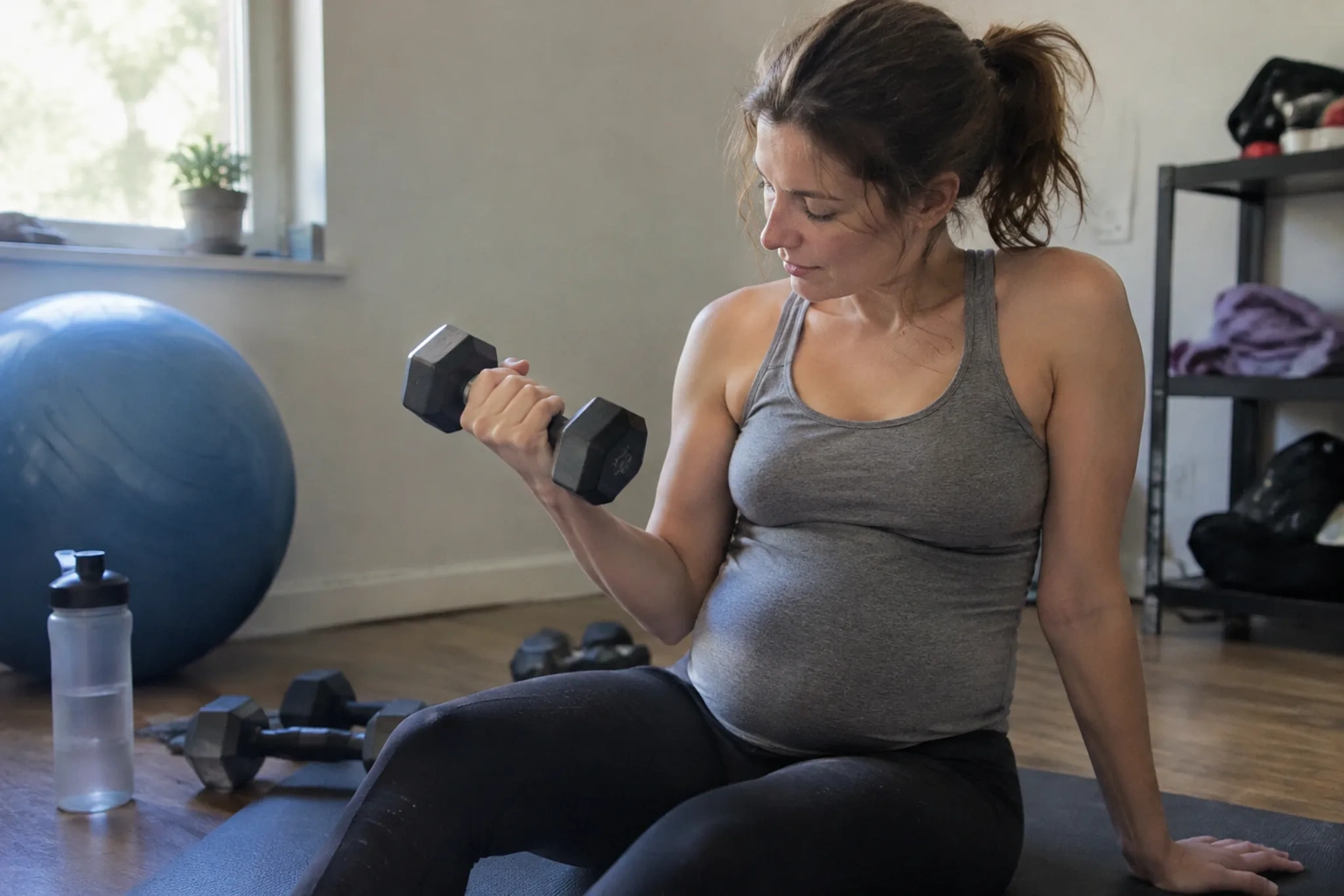
The practical response in these weeks is to lower the ambition of each session while keeping the habit. Two or three shorter sessions a week, with the same movement patterns at reduced volume, preserve the neural patterns and the routine without demanding recovery the body does not have to give. A session that would have been five sets of five becomes three sets of five at a weight that leaves several reps in reserve. It feels like backing off. It is backing off. That is the correct move.
There is a specific trap here. Lifters are trained to push through fatigue, and that instinct is exactly wrong in early pregnancy. The adaptation curve is no longer the one they have spent years learning to read. A missed rep or a failed set in this period is not a signal to add more rest and try again; it is a signal that the day's plan was too much. Treating early pregnancy like a deload block, rather than like a training camp, keeps the habit intact and avoids the minor injuries that come from grinding when the body is already spent.
The Second Trimester Reward and the New Center of Gravity
For many women, the second trimester is the best training window of the pregnancy. Nausea fades, energy returns, and the belly is not yet large enough to interfere with most movements. This is the stretch where a cautious program can look almost normal. It is also the stretch where complacency sets in, because the body feels capable right up until the moment a position stops working.
The change that catches lifters off guard is the shift in center of gravity. As the uterus grows, the body's mass moves forward, and the lower back and pelvis take on a different load. Exercises that were trivially stable become subtly harder to balance. A heavy back squat that felt planted at twelve weeks can feel wobbly at twenty, not because strength has dropped but because the base has changed. The fix is usually positional: a wider stance, a heel elevation, a switch from barbell to dumbbell, or a move to a trap bar. The lift survives; the setup does not.
The second trimester is also when lying flat on the back becomes a problem for many women. The weight of the uterus can compress the vena cava, the large vein that returns blood to the heart, and some people feel dizzy or nauseated within a minute or two of lying supine. The practical adjustment is simple: bench presses and floor presses move to an incline, and any exercise that requires a long supine hold gets a wedge or gets replaced. This is not a reason to stop pressing. It is a reason to press at an angle.
Exercises That Quietly Stop Making Sense
Some movements do not fail because the lifter is weaker. They fail because the geometry of the body has changed enough that the movement no longer fits. Deadlifts from the floor are the clearest example. As the belly grows, the starting position becomes a compromise between reaching the bar and keeping the spine in a safe position, and the compromise usually resolves in favor of a rounded back. A sumo stance, a block pull, or a switch to a Romanian deadlift from mid-thigh preserves the posterior chain work without the floor-level conflict.
Deep squats and any movement that requires a full range of hip flexion run into a similar wall. The belly meets the thighs before the bottom is reached, and forcing depth becomes a compensation. Elevating the heels, widening the stance, or reducing depth are all legitimate answers. The ego cost of a shorter range of motion is real and worth naming. A lifter who has spent years chasing depth will feel the loss. But a squat to a box that stops two inches above the old bottom is still a squat, and it is a squat the body can recover from.
Direct abdominal work is the other category that needs editing rather than elimination. Crunches and leg raises put strain on a midline that is already stretching. Most guidance suggests replacing them with anti-rotation and bracing work, such as Pallof presses, dead bugs, and carries, which train the trunk to resist movement rather than to flex repeatedly. This is not a punishment. It is a better match for what the trunk is being asked to do for the next several months.
The Pelvic Floor Is Part of the Program
Strength training during pregnancy without attention to the pelvic floor is a project with one wall missing. The pelvic floor is a group of muscles that supports the uterus, bladder, and bowel, and it is under increasing load as the pregnancy progresses. Heavy lifting raises intra-abdominal pressure, and the pelvic floor is one of the structures that has to manage that pressure. Some women tolerate this well. Others develop leaking, heaviness, or discomfort during or after sessions.
The sensible response is to learn what the pelvic floor is doing. A physiotherapist who specializes in pelvic health can assess whether the muscles are contracting, relaxing, and coordinating properly, and can teach breathing strategies that keep pressure from being driven downward during a lift. The simple version, for anyone not ready to book an appointment, is to exhale through the hardest part of a rep rather than bracing with a held breath. That single change reduces the downward load on the floor during a lift, and it costs nothing.
The leaking that some women experience during pregnancy is common and treatable, and it is not a normal cost of being strong. Treating it as a private annoyance to push through is the mistake. A pelvic health assessment in the second trimester, before symptoms become entrenched, is the kind of preventive appointment that pays for itself.
When to Stop the Set and Call the Provider
Any program needs a stop sign. The list of symptoms that should end a session and prompt a call to a provider is short and worth memorizing: vaginal bleeding, fluid leaking, regular painful contractions, chest pain, shortness of breath that does not resolve with rest, dizziness or fainting, calf pain or swelling, and a decrease in fetal movement. These are not signs to work through. They are signs to stop.
The less dramatic signals live in a gray zone. A twinge in the round ligament, a feeling of heaviness in the pelvis, a sudden inability to brace on a lift: these are not emergencies, but they are information. A lifter who notices a new sensation during a session has a choice between pushing through and adjusting the session. The adjustment is almost always the better bet, even if it turns out the sensation was nothing.
A Three-Week Reset Instead of a Nine-Month Plan
Programs that stretch nine months tend to be fiction. Too much changes, too quickly, for a fixed plan to survive contact with the second and third trimesters. A more useful approach is to review the training every three weeks and adjust based on three questions: what still feels stable, what has started to feel wrong, and what the provider said at the last appointment. That review is short, and it is enough.
The three-week reset also handles the psychological side. A lifter who commits to a nine-month plan and then abandons it in month five feels like a failure. A lifter who revises every three weeks never has to abandon anything; she simply updates. The identity survives the pregnancy because it was never tied to a specific weight on a specific bar.
The women who come out of pregnancy still lifting are rarely the ones who trained hardest or the ones who trained most conservatively. They are the ones who treated the whole nine months as a series of small, honest negotiations, and who were willing to lose a little weight on the bar in exchange for keeping the habit alive.