







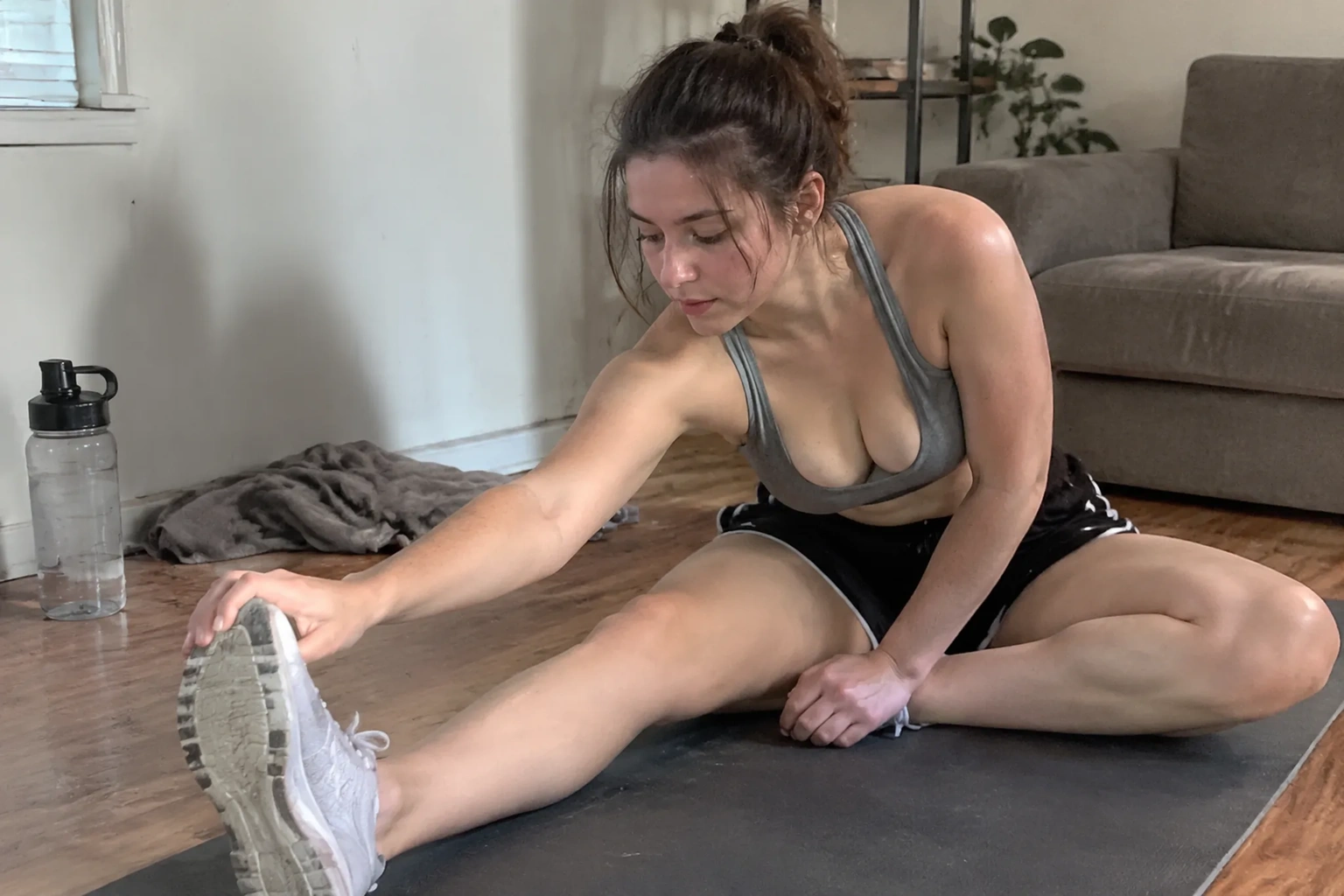
Static stretching before a run has been losing a public relations war for roughly three decades. The evidence against the long, held hamstring pull before exercise is decent and widely reported, and the fitness industry has largely moved on to dynamic warm-ups, leg swings, and foam rollers. That is a reasonable correction. It has also produced a strange side effect: a generation of people who treat all stretching as suspect, and who then stretch badly, rarely, or only after something already hurts. The stretches themselves are not the danger. The way most people do them, and the timing, is.
Watch a group of recreational runners before a weekend race and the pattern shows up fast. One person drops into a deep lunge and bounces, trying to force the hip flexor to give. Another grabs a foot behind the back and yanks it toward the glute, holding a face that suggests the effort of a deadlift. A third does the classic toe touch, knees locked, and bobs up and down for thirty seconds. None of these movements is exotic. All three carry a small, avoidable risk that has nothing to do with whether stretching is good for a person.
The bounce is the first thing to go
Ballistic stretching, the bouncing kind, is the oldest bad habit in the book. The idea is that a little rhythmic force will coax a tight muscle into giving up length. What actually happens is that the muscle, sensing a sudden stretch, contracts to protect itself. The body treats a fast, unbuffered pull as a threat, and the stretch reflex fires. The person feels progress because the bouncing creates a brief window of give, but the muscle is fighting the whole time.
The risk is not catastrophic, and plenty of athletes bounce without injury. But the payoff is poor. A slow, steady hold gets the same or better result with far less chance of pulling something, especially in the cold. Muscles are more pliable when warm, and a bounce on a cold hamstring is the least forgiving version of the move. The fix is simple and unglamorous: hold still, breathe, and let the tissue settle instead of forcing it.
Holding a stretch into pain
There is a line between a stretch that feels like productive tension and one that feels like a warning. Most people cross it without noticing, because the culture around stretching treats discomfort as proof of progress. A stretch should feel like a firm pull, a clear signal that the tissue is at its current limit. It should not feel sharp, hot, or electric. Those sensations are the body's way of saying the joint is being asked for more than it has.
The practical test is simple. If the face is contorted and the breath is held, the stretch is too deep. A person should be able to hold a conversation, or at least breathe slowly and evenly, through a hold. If the breath stops, the nervous system tightens, and the muscle does the opposite of what the stretch is trying to achieve. Easing back ten percent usually produces more length over time than forcing the last ten.
Pain during a stretch is also a poor guide to which tissue is actually tight. A hamstring that feels tight may be guarding because the lower back is stiff, or because the hips are weak, or because the person sat in a chair for nine hours. Stretching the hamstring harder in that case treats a symptom and ignores the cause. The tightness often returns within a day, which is the tell that the stretch was addressing the wrong thing.
Locked joints and the knee that pays for it
The locked knee is a quiet offender. In a standing hamstring stretch or a toe touch, many people straighten the knee as far as it will go and then hinge from the waist. The knee joint is not designed to hyperextend under load, and forcing it straight while the hamstring pulls back puts stress on the back of the knee, the joint capsule, and the ligaments that keep the shin from sliding too far forward.
People with naturally hypermobile knees are at the most risk here, and they are often the last to know it. A knee that bends slightly past straight feels normal to its owner and alarming to everyone else. The fix is to keep a soft, micro-bent knee during standing stretches, which protects the joint and actually lets the hamstring lengthen more, because the muscle is not being asked to fight a locked joint at the same time.
The same logic applies to the lower back. A standing toe touch rounds the spine, and the hamstrings are rarely the limiting factor. Most people who cannot touch their toes are limited by hip hinge mechanics and back stiffness, not hamstring length. Bending over and yanking does little for the hamstring and asks a lot of the lumbar discs. Sitting down to stretch the hamstring, with a neutral spine, is a smaller ask with a better return.
Stretching cold tissue first thing in the morning
Morning is when the body is stiffest. Discs are hydrated after a night of lying down, the spine is at its most vulnerable to flexion, and the muscles are cool. A deep forward fold or an aggressive spinal twist within minutes of waking is the least forgiving version of the movement. The tissue is not warmed, the joints have not moved through their range yet, and the nervous system is still half asleep.
This does not mean morning stretching is off the table. It means the first ten minutes should be gentle movement, not a held end-range pose. A few slow cat-cows, some hip circles, a walk around the room, and then a moderate stretch if the body still wants one. The people who hurt themselves stretching almost never do it mid-afternoon after a walk. They do it at 6 a.m. on a cold floor, trying to touch their toes before coffee.
The hamstring grab behind the back
The standing quad stretch, foot pulled behind the glute, is one of the most common moves in any warm-up and one of the easiest to do badly. The problem is the knee. Pulling the heel toward the buttock with force bends the knee sharply while the hip is extended, and if the person also arches the lower back to get more range, the knee and the lumbar spine both take the load. The quad gets a stretch, but so does the front of the knee joint, which is not what anyone signed up for.
A safer version keeps the standing leg soft, the pelvis tucked slightly, and the pull gentle. The heel comes toward the glute, but the knee stays pointed at the floor rather than flaring out, and the hand holds the ankle without yanking. If balance is shaky, a wall or chair is fine. Falling out of a stretch is a real injury mechanism, and it is almost always preventable with a hand on something stable.
Holding one stretch for two minutes
Long holds have a devoted following, and there is a place for them in a dedicated mobility practice. The problem is the person who reads that long holds are good and then holds a single hamstring stretch for three minutes on each side, once, on a cold Tuesday. That is a lot of time in one position for one tissue, and it does not make up for a week of sitting.
For most recreational purposes, thirty to sixty seconds per stretch, repeated a couple of times, covers the ground. The tissue responds to frequency more than duration. Five minutes of stretching most days beats a heroic twenty-minute session on Sunday, and it is far less likely to produce the soreness that convinces people stretching is not for them. The body adapts to what it does often, not to what it does dramatically.
Stretching a joint that is already unstable
There is a category of person for whom stretching is genuinely the wrong tool: the hypermobile. Loose joints, a history of sprains, a body that bends further than it should. For this group, the tissue is already long, and pulling it further does not solve the problem, which is usually a lack of strength and control at the end range. A hypermobile shoulder or knee that gets stretched daily tends to get sorer, not better.
The signal is a stretch that feels like nothing, or a joint that can move past what looks normal. If a person can rest their palms on the floor with straight legs and no warm-up, or bend a thumb back to the wrist, the hamstring does not need more length. It needs strength through the range it already has. A physiotherapist can sort out which camp a person is in, and it is worth the visit if the answer is not obvious.
The stretch that replaces the warm-up
The most common mistake is not a bad stretch. It is the belief that stretching is a warm-up. A held hamstring stretch does not raise core temperature, does not prime the nervous system, and does not prepare the joints for load. It is a quiet, passive activity that happens to involve the muscles. Treating it as the ten minutes before a run or a game leaves the body underprepared for what comes next.
A proper warm-up looks different: easy movement, gradually increasing intensity, the joints moving through their range under low load. Leg swings, walking lunges, arm circles, a slow jog. Stretching can come after, when the tissue is warm and the body is ready to settle. The order matters more than most people realize, and getting it right removes a surprising amount of the risk that stretching gets blamed for.
When the stretch is covering for something else
A persistent tightness that does not respond to stretching is a message. The calf that stays tight no matter how many times it is stretched may be protecting an Achilles that is irritated. The low back that feels tight every morning may be asking for core strength, not length. The hip that will not open may be a hip that needs to be loaded, not pulled.
Stretching is a useful tool, and it is a poor substitute for diagnosis. When a tight area has been tight for months, and the stretch produces relief for an hour and then nothing, the body is pointing somewhere else. A physiotherapist or a good coach can read that signal. The stretch was never the problem. Using it as the only answer was.





















