







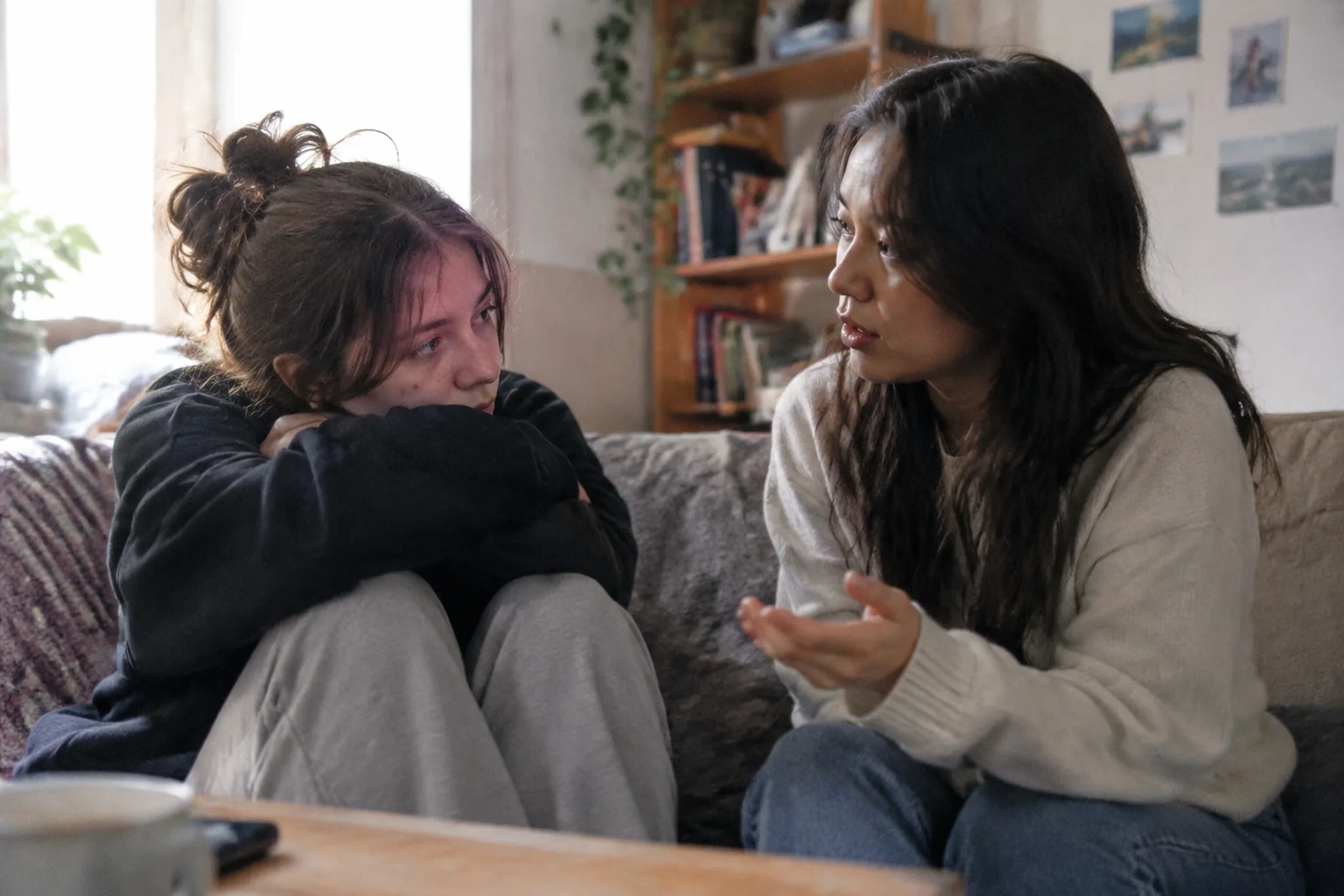
Claire had been sitting on the same couch for twenty minutes before she said anything that mattered. The television was on with the sound low, two mugs going cold on the coffee table, and her friend Marcus had already asked twice whether she wanted to talk about the thing with her sister. She had said no both times. The third time, she didn't say no. She said, "I don't know how to start," and then she cried for a while, and Marcus did the single most useful thing available to him: he stayed.
That scene is the whole subject in miniature. Most writing about mental health conversations treats them as an event with a script, a right question, a wrong question, a moment of disclosure that must be coaxed out. The lived version is messier and quieter. A person who is struggling rarely needs an interviewer. They need someone who has not already decided how the conversation should go.
Pressure is the thing that ruins these talks, and it almost never announces itself as pressure. It arrives dressed as care.
The well-meaning question that closes a door
"How are you, really?" sounds warm on paper. Said to a person who has spent three weeks rehearsing "I'm fine," it can land like a spotlight. The word "really" implies that the ordinary answer is a lie and that the asker knows it. A person who is not ready to be seen will simply harden.
The alternative is not a cleverer question. It is a lower-stakes one, or none at all. "Want to get out of the house for an hour?" carries the same concern without demanding a confession. So does "I've got nowhere to be until four."
Friends tend to overestimate the value of the perfect opening line and underestimate the value of duration. A conversation about mental health is usually not one conversation. It is the fourth or fifth in a series, and the first three were about nothing.
Why "just reach out" fails as advice
There is a common piece of advice given to people who are struggling: reach out. It is well meaning and mostly useless, because it puts the entire burden of initiation on the person with the least energy. The same flaw runs through advice given to friends: be available, and they will come to you.
A person in a low place often cannot assemble the sentence "I am not doing well and I would like company." The sentence requires them to name the problem, admit it out loud, and risk the listener's reaction, all in one breath. Most people would rather stay silent for another month.
So the friend who wants to help has to do the initiating, repeatedly, without keeping score. A text on a Tuesday afternoon that says "thinking of you, no reply needed" asks nothing. It also leaves a door propped open. The person can walk through it on their own schedule, or not, and either way nothing has been demanded.
The friend who fixes versus the friend who stays
There is a particular kind of helper who cannot tolerate a problem left unsolved. Within ninety seconds of hearing that someone is struggling, this person has produced a therapist's name, a yoga studio, a book, a supplement, and a plan for the weekend. The advice is often good. It still lands badly, because the person on the couch has not yet been heard.
The urge to fix comes from discomfort. Sitting with someone who is unhappy is unpleasant, and offering a solution discharges that unpleasantness onto the other person. It makes the helper feel useful. It makes the struggling person feel like a project.
A friend who stays does something harder. They let the silence sit. They ask a question and then wait through the pause that follows, the one that lasts four seconds and feels like forty. They say "that sounds exhausting" instead of "have you tried." None of this is passive. It is active restraint, and it takes more skill than advice-giving.
What to say when the words run out
People freeze in these conversations because they fear saying the wrong thing. The fear is reasonable, and the escape is to aim for small and true rather than profound and correct.
"I'm glad you told me" is nearly always safe. So is "I don't know what to say, but I'm here." That second one is underrated. It admits the awkwardness instead of papering over it, and it gives the other person permission to be awkward too.
What to avoid is anything that ranks the problem, minimizes it, or turns it into a lesson. "Other people have it worse" is a comparison the speaker did not ask for. "Everything happens for a reason" is a philosophy nobody requested at a kitchen table. "You should really see someone" is often correct and almost always better saved for a later conversation, after trust has been built.
The sentence that does the most work in these moments is short and boring: "Tell me more." It signals that the listener has time and is not horrified. It cedes the floor. A person who has been carrying something heavy for months will often talk for ten minutes straight once they hear it.
The invitation that leaves an exit
Pressure hides inside invitations that are too big. "Come over for dinner" requires energy: showering, dressing, small talk, eating in front of someone. For a person in a low patch, that can be an insurmountable list. The invitation declines itself.
A smaller ask works better. "I'm dropping off soup at six, I'll leave it on the step, no need to come out." "I'm going to the hardware store Saturday morning, want to ride along?" Errands are excellent because they are parallel, not face-to-face. Two people in a car looking out the windshield can say things they could never say across a table.
The other trick is the exit. Any invitation that includes an easy way out ("stay for ten minutes if you're up to it, no pressure to stay longer") is more likely to be accepted than one that assumes a whole evening. The exit is what makes the invitation safe. The person can show up, discover they have five minutes of social capacity, and leave without explaining.
When the conversation turns serious
Sometimes a friend says something that is bigger than a bad week. They mention not seeing the point of anything, or wanting to disappear, or sleeping fourteen hours a day for a month. These are the moments where a friend's instinct to keep things light can become a liability.
The move here is to slow down, not to panic and not to leap into crisis mode. "That sounds really heavy. How long have you been feeling like that?" is a question that opens the conversation instead of slamming it shut. If the answer suggests the person is in danger, the next step is to help them connect with real support, and to stay in the room while they do it.
Friends are not clinicians and should not try to be. The job is to notice, to ask, to listen, and to help a person get to someone qualified if that is what the situation calls for. A friend who attempts to diagnose will usually get it wrong, and a friend who promises to keep a serious secret may end up carrying something they cannot hold. It is fair to say out loud: "I care about you too much to keep this to myself. Let's find someone who knows how to help."
The follow-up text that decides everything
Most conversations about mental health do not fail in the moment. They fail in the week after. The friend who listened on Sunday means to check in on Tuesday and then forgets, and the person who disclosed something raw on Sunday notices the silence and concludes they said too much.
A short follow-up changes the whole arithmetic. It does not have to be earnest. "How'd the thing with your landlord go?" works, because it proves the conversation was not a one-off and that the listener remembered a detail. Something like "still thinking about what you said, no need to respond" works too. Both say the same thing: you were not a burden, and I am still here.
This is the part nobody writes about, and it is the part that matters most. A single good conversation is a nice moment. A friend who checks back in three days later is a different category of support entirely.
Claire still remembers that Marcus did not ask her what was wrong that night. He asked whether she wanted the blanket, and then he let the silence run, and when she finally started talking he did not interrupt once. The next Saturday he texted to ask if she wanted to walk to the corner store for milk. She said yes. They did not discuss her sister at all.





















