







Gut health has become the wellness equivalent of the stock market: everyone has an opinion, the advice contradicts itself daily, and the people with the most confidence tend to have the least useful information. Meanwhile the actual biology is unglamorous. A few hundred species of bacteria live in the human colon, fermenting fiber, training immune cells, and producing short-chain fatty acids that keep the intestinal lining intact. That system responds to what gets eaten, how fast, how often, and how much sleep and stress surround the meal. None of it requires a $60 probiotic or a stool test ordered from a podcast ad.
The problem is time. A person working a full day, commuting, wrangling children or aging parents, and falling into bed with a phone does not have an hour to steam vegetables and chew each bite forty times. So the useful question is not what the ideal gut routine looks like. It is what survives contact with a Tuesday.
The fiber number that actually matters
Most adults in industrialized countries eat somewhere in the range of 15 grams of fiber a day. Public health guidelines generally point toward 25 to 30 grams, and the gap between those two numbers is where most gut complaints live. Fiber is the primary fuel for colonic bacteria. Feed them little and the population shifts toward species that thrive on mucus and fat, which is a less comfortable arrangement for the host.
Counting grams is miserable, though, and nobody sustains it past a week. A workable shortcut: one fiber-dense food at every eating occasion. Black beans in a lunch bowl. A pear at 3 p.m. instead of the second coffee. Frozen edamame microwaved with salt as a pre-dinner snack. Oats at breakfast, which pull double duty because beta-glucan in oats ferments slowly and tends to produce less gas than a sudden kale habit.
The busy person's version of fiber loading is not a salad the size of a pillow. It is a can of chickpeas rinsed and dumped into whatever sauce is already simmering. It is the bag of frozen mixed berries that goes into yogurt because fresh ones rot in the drawer. Small, repeatable, boring.
Variety beats volume, and the freezer does the work
Gut bacterial diversity correlates with diet diversity more reliably than with any single superfood. A person eating thirty different plant foods a week tends to have a more varied microbiome than one eating the same large salad daily. Thirty sounds absurd until frozen vegetables enter the picture, because frozen peas, corn, spinach, and edamame count, and so do nuts, seeds, herbs, spices, and legumes. A bag of frozen stir-fry mix alone can carry four or five plants.
The practical move is to stop treating variety as a cooking project and start treating it as a pantry problem. Keep three kinds of canned beans, two kinds of frozen vegetables, a bag of mixed nuts, and a jar of seeds. Rotate. A bowl of soup made from canned tomatoes, white beans, and frozen spinach hits four plant foods before anyone has chopped anything.
Fermented foods are a small daily habit, not a supplement subscription
Fermented foods carry live cultures that can transiently shift the gut environment. The evidence for large, permanent colonization from a spoonful of yogurt is thin, but the evidence for modest, useful effects from regular consumption is reasonable and growing. The key word is regular, and the second key word is cheap.
A few forkfuls of sauerkraut on eggs. A half cup of plain kefir blended into a smoothie. A spoon of miso stirred into broth at the end of cooking, off the heat, so the cultures survive. Refrigerated kimchi from the grocery store rather than the shelf-stable kind, since the latter has usually been pasteurized and the cultures are gone.
What does not help: a $45 bottle of capsules taken inconsistently. Probiotic supplements vary wildly in strain and dose, and the research picture is muddled enough that a person without a specific medical reason is mostly paying for packaging. Food is cheaper and better studied.
The five-minute window before the meal
There is a step that costs nothing and gets skipped constantly: sitting down, unhurried, before eating. Eating at a desk while answering email, or standing at the counter shoveling leftovers, puts the body in a sympathetic state. Digestion runs on the parasympathetic side. A person who eats a perfectly respectable lunch while stressed can end up bloated and gassy from a meal that would have been fine eaten calmly.
The fix is embarrassingly simple. Three slow breaths before the first bite. Putting the phone face down. Chewing enough that the fork comes down between bites. None of this is mystical. It just gives the gut a chance to receive food under conditions it can work with.
Meal timing and the late-dinner problem
The gut has a circadian rhythm. Motility, enzyme secretion, and the composition of the microbiome all shift across the day, and the system is better prepared for food earlier than later. A dinner eaten at 10 p.m. and followed by bed at 10:30 tends to sit heavier than the same meal at 6:30, and reflux, bloating, and poor sleep often follow.
For people whose schedules make early dinner impossible, the compromise is portion size and gap. A lighter evening meal, and at least two hours between the last bite and lying down, does more than any supplement. A handful of nuts at 9 p.m. is a smaller insult than a full plate of pasta.
Breakfast matters for the opposite reason. A morning meal, ideally with some fiber and protein, tends to support steadier blood sugar and a calmer gut through the day. Skipping it is not a crime, but a person who skips breakfast and then eats a huge late lunch and a later dinner has stacked the deck against the system.
Sleep, stress, and the gut-brain line
The gut and brain communicate constantly through the vagus nerve and through chemical signals, and chronic stress measurably changes gut motility and barrier function. This is why a person can eat impeccably and still feel awful during a brutal work quarter. It is also why "just take a probiotic" is such thin advice.
Sleep is the lever most people can actually pull. Short sleep nudges food choices toward sugar and refined carbs, which feeds the less helpful bacteria, and it raises stress hormones that slow digestion. Seven hours is not a wellness slogan. It is a gut intervention that happens to be free.
For stress, the realistic version is not a meditation retreat. It is a ten-minute walk after lunch, which supports motility and blood sugar and costs nothing but a pair of shoes. Or a hard stop on work email at a fixed hour, which is less about the email and more about the nervous system getting a signal that the day has ended.
When to stop self-managing and see someone
Persistent bloating, unexplained weight loss, blood in the stool, or a change in bowel habits that lasts more than a few weeks are not gut-health-project problems. They are reasons to see a doctor. The busy person's checklist is a maintenance routine for a system that is basically working. It is not a diagnostic tool, and treating it like one is how people lose months to internet rabbit holes.
There is also a subtler trap: the person who has tried every elimination diet, cut out gluten, dairy, and nightshades, and still feels terrible. Restriction narrows dietary diversity, which is the very thing the microbiome needs. A very limited diet sustained for months can make the gut environment worse while the original problem goes unaddressed.
The checklist, stripped to what fits a real week
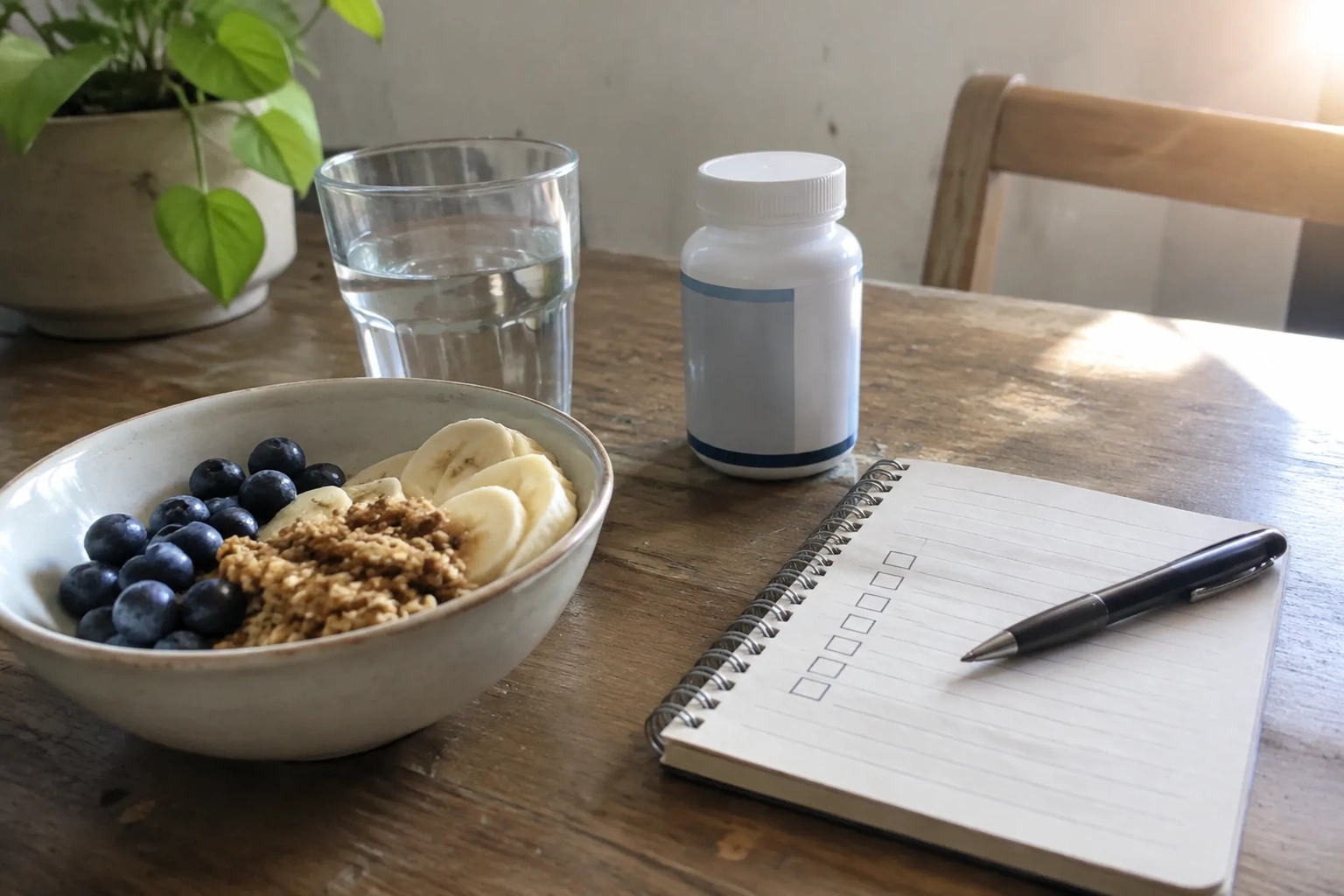
One fiber-dense food at each meal. Three kinds of plants in the pantry or freezer at all times, rotated. A small serving of something fermented five days out of seven. Three breaths before eating. A two-hour gap between dinner and bed. Seven hours of sleep. A short walk after lunch. A doctor's visit for anything that does not settle.
That list fits on an index card and costs less than one bottle of supplements. It is also, almost certainly, the version a person will actually follow. The best gut protocol is the one that survives a bad week, a late meeting, and a Tuesday night when the only dinner option is a can of chickpeas and a bag of frozen spinach.
Which, incidentally, is a perfectly good dinner. Rinse the chickpeas, wilt the spinach in a pan with olive oil and garlic, add a squeeze of lemon and a spoon of plain yogurt on top. Twelve minutes, four plant foods, one live culture. The gut does not need a program. It needs a cook who keeps the freezer stocked and the phone face down at the table.





















