







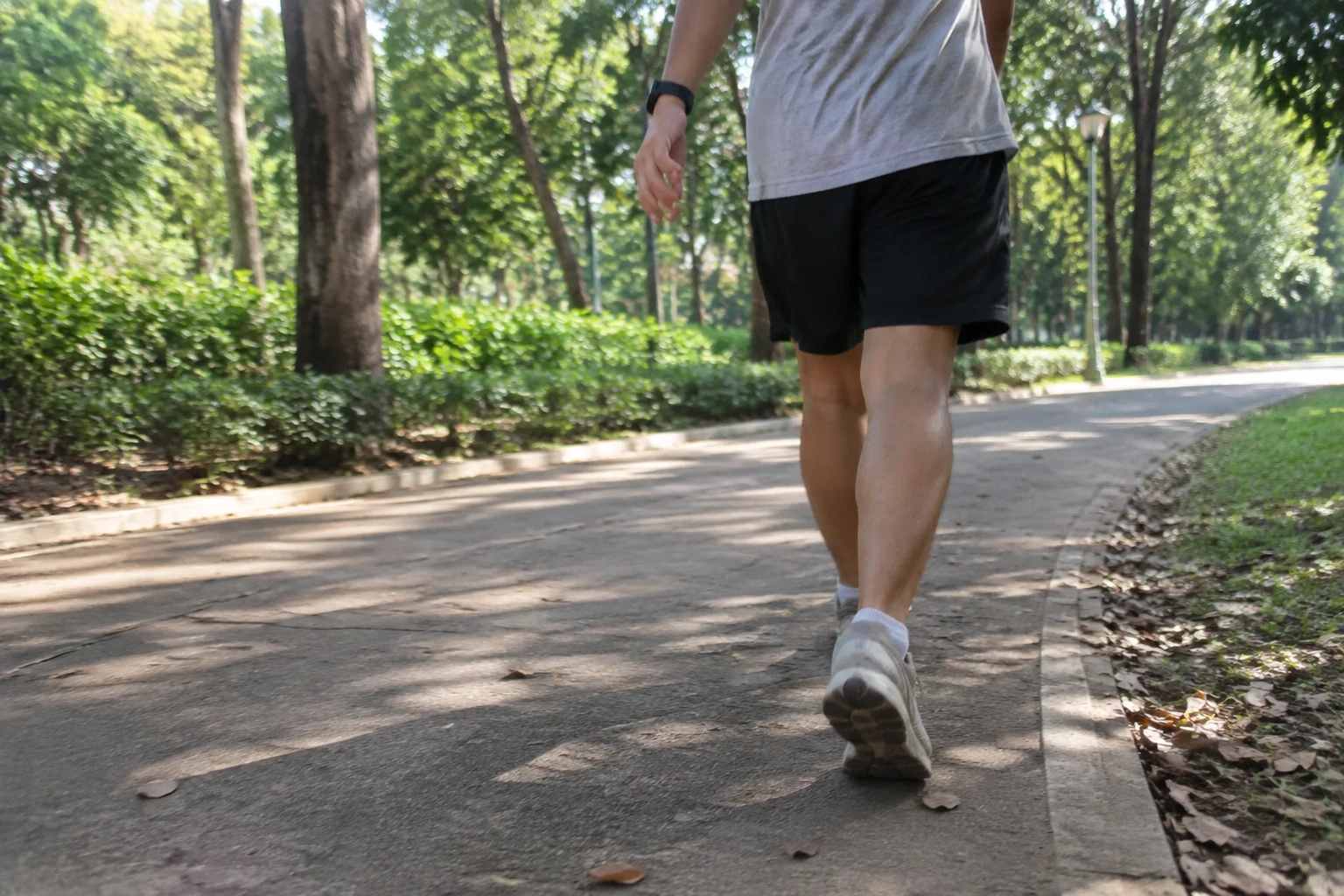
Ten thousand steps is the most successful piece of fitness marketing ever devised, and almost nobody who repeats it knows where it came from. The number traces back to a 1960s Japanese pedometer called the manpo-kei, which literally translates to "ten-thousand-step meter." It was a slogan before it was a study, and the research that followed has been kinder to the slogan than it deserves. Walking matters enormously. The specific number matters far less, and the fixation on it has quietly ruined the habit for millions of people who hit 4,000 steps, feel like failures, and stop counting.
A daily walk is one of the few health habits that requires no equipment, no subscription, no special clothing, and no particular talent. It also has an astonishing failure rate. Gyms track their attrition closely; walking has no such accounting, but the evidence is everywhere, in the elliptical machines gathering dust and the running shoes bought in January and abandoned by March. The puzzle of the daily walk is why something so easy is so hard to keep.
The answer sits in the gap between walking as a vague intention and walking as a scheduled event with a time, a route, and a reason.
Why the First Two Weeks Feel Like a Chore
Most walks fail early, and they fail for a mundane reason: the body is fine, but the logistics are not. A person decides to walk daily, leaves the house the first morning at whatever time is convenient, takes whatever route looks pleasant, and returns feeling virtuous. Day two works too. By day four, the route has lost its novelty, the time has drifted, and a meeting has appeared where the walk used to be.
Novelty is a terrible fuel source. It burns hot and runs out in roughly 72 hours. What survives that window is structure: a fixed departure time, a route short enough to be non-negotiable, and a destination. The walk that survives is boring. The walk that dies is the one that was exciting.
There is also the weather problem, which is really a clothing problem in disguise. A person who owns no rain jacket will not walk in the rain, no matter how strong the intention. A person who owns one will. The obstacle is rarely motivation. It is a missing item hanging by the door, or rather not hanging there.
The Ten-Minute Rule That Beats a Thirty-Minute Goal
Thirty minutes sounds modest until it competes with a Tuesday. Ten minutes competes with almost nothing. A ten-minute walk is shorter than a phone call, shorter than a coffee, short enough that skipping it feels more absurd than doing it. The trick is that ten minutes almost never stays ten minutes. Once the shoes are on and the door is closed, the walk tends to extend itself, because the hardest part of any walk is the first ninety seconds.
This is why goal-setting advice often backfires on walkers. A thirty-minute target creates thirty separate decisions, one for each minute, and the mind is excellent at finding reasons to stop at minute nineteen. A ten-minute target creates one decision, made at the door. Make the commitment small enough that the decision is trivial, and let the walk surprise itself.
There is a useful corollary here about counting. Steps are a fine measurement and a poor master. A pedometer that reports 3,200 steps at the end of a ten-minute walk is reporting success, but a person comparing it to a 10,000-step goal will read it as failure. The number is doing emotional work it was never designed to do. Better to track days walked than steps taken, at least at the start.
Route Design: Loops, Landmarks, and the Case Against the Treadmill
A good walking route has three properties. It is a loop, so there is no decision about when to turn back. It passes at least one landmark worth noticing, a bakery, a stand of trees, a view of water, so the walk has a small reward built in. And it is short enough to be completed in bad weather without misery.
The treadmill deserves a fair hearing and mostly loses. It solves weather and safety, which are real problems, and it removes the two things that make walking psychologically sticky: changing scenery and a sense of arrival. A person on a treadmill is walking to nowhere, and the mind knows it. The machine also tends to become a shelf. The outdoor walk, even in drizzle, ends somewhere.
Route variety matters less than route reliability. The same loop walked daily for a month becomes a kind of moving meditation, familiar enough that the mind can wander, which is where the real benefit of walking often lives. Walking is one of the few activities that occupies the body just enough to free the mind, and a familiar route frees it faster than a novel one.
Walking With Other People, and the Case Against It
Walking companions are a double-edged arrangement. A committed partner makes the walk harder to skip, which is the whole point. A flaky partner makes the walk easier to skip, because now there is a reason to cancel that belongs to someone else. The safest arrangement is a companion with a more reliable schedule than one's own, or no companion at all.
Group walks have their own gravity. They tend to speed up, which turns a pleasant stroll into a fitness event, or slow down into a standing conversation, which turns it into a social hour with occasional movement. Neither is wrong, but neither is the solitary daily walk that the habit actually depends on. The daily walk is best protected as a private appointment, with social walking treated as a separate pleasure.
What Walking Actually Does to a Day
The benefits of a daily walk are usually described in the language of long-term health, which is accurate and useless for habit formation. Nobody walks on a rainy Tuesday because of a reduced risk of heart disease decades from now. The immediate effects are the ones that keep the habit alive, and they are worth naming.
A walk interrupts sitting, and sitting is the default state of most modern work. Twenty minutes of walking after a meal is one of the most reliable ways to feel less sluggish in the afternoon, a fact well known to anyone who has tried it and poorly known to anyone who has not. The walk also functions as a boundary, a clear separation between the workday and the evening, which is harder to achieve when the commute is a walk from the desk to the sofa.
There is a subtler benefit that walkers describe and researchers have struggled to quantify: the walk is where thinking happens. Not the focused thinking of a desk, but the loose associative thinking that produces the good idea three hours later. Many writers and scientists have kept walking routines for exactly this reason. The walk is not a break from work. It is a different kind of work.
Clothing and Gear That Earn Their Place by the Door
The gear list for a daily walk is short, and everything on it should live by the front door. A pair of shoes that can get wet and muddy without regret. A jacket with a hood, because umbrellas are a commitment and hoods are not. A hat for cold mornings and a cap for bright ones. That is the whole kit, and the reason it matters is friction: anything stored in a closet is one extra step between a person and the walk.
This is where most walking advice goes wrong. It recommends a fleece, a vest, technical socks, a fitness tracker, a hydration belt. None of these are harmful, and all of them add decisions. A person who needs to assemble an outfit before walking will walk less often than a person who needs to grab a jacket. The best walking wardrobe is the one that requires no thought.
When the Streak Breaks
Every daily habit eventually breaks. Illness, travel, a newborn, a bad week at work. The important fact about a broken streak is that it has no power on its own. The damage comes from the story a person tells about it, the quiet conclusion that the habit was never real, that the walking was a phase, that it is easier to stop than to restart.
The antidote is to plan the restart before the streak breaks. A person who knows that a missed week means a return to the ten-minute loop, not the thirty-minute ambition, will restart faster. A person who treats the missed week as proof of failure will restart in April, if at all.
The Walk That Outlasts the Resolution
The daily walk that survives the year is almost always unimpressive. It is a short loop, in the same direction, at the same time, in clothes that hang by the door. It produces no dramatic transformation, no before-and-after photo, no story worth telling at a dinner party. It just happens, most days, in the rain and the dark and the ordinary middle of a life, and the person doing it stops thinking of it as exercise and starts thinking of it as the part of the day when things make sense.
That is the only reliable marker of a habit that will last. Not the step count, not the pace, not the distance, but the moment the walk stops being a thing a person has to do and becomes a thing a person would miss. The shoes stay by the door. The loop stays the same. The walk happens.





















