







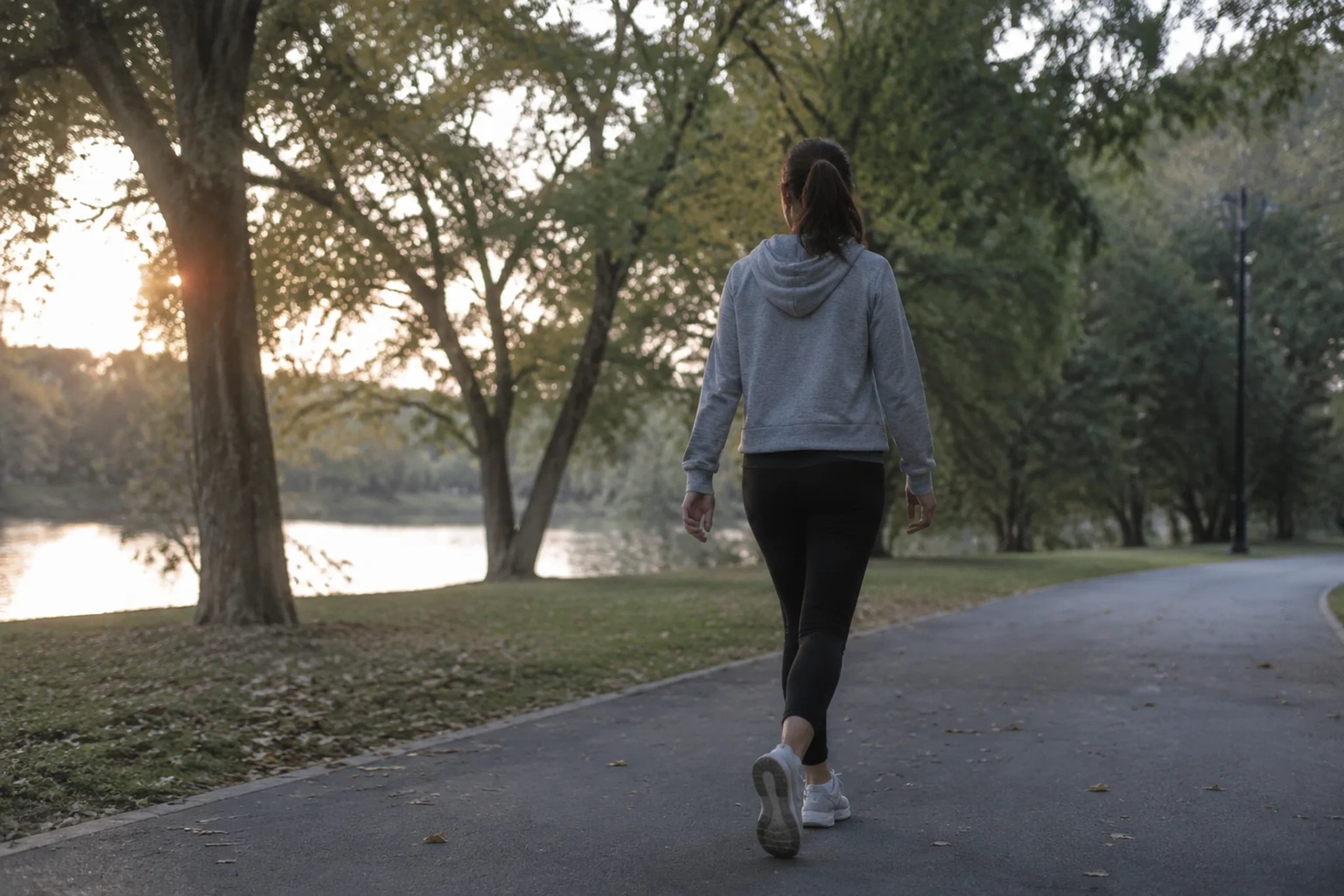
Walking is the only exercise most people already know how to do and still manage to avoid. That sentence sounds like a joke, but it holds a real problem: the barrier to walking is almost zero, which means the excuses have to be manufactured, and people manufacture them expertly. A gym membership can be cancelled. A pair of running shoes can wear out. Walking has no such exit. It sits there, free and available, and the refusal has to be actively chosen every single day.
That is why starting a walking habit is less about fitness than about negotiation. The body is willing. The schedule is the obstacle. And the schedule is where most attempts quietly die.
The ten-minute rule that gets a body out the door
The most common failure in beginning a walking practice is ambition. A person decides to walk for an hour, does it once, feels virtuous, and then cannot find another hour for six days. The habit collapses under the weight of its own first success.
A better opening move is ten minutes. Not as a warm-up to something larger, but as the actual target. Ten minutes is short enough that almost no schedule can honestly reject it, and long enough to count. The point of the first two weeks is not distance or heart rate. It is repetition: teaching the day to expect a walk.
Ten minutes also removes the clothing problem. There is no need for special shoes, a hydration pack, or a change of clothes. A person steps outside in whatever they are wearing and returns before the kettle finishes cooling. The lower the setup cost, the more often the walk happens.
Why the first week should feel almost too easy
Walkers who quit in week three usually went too hard in week one. Sore shins, blisters, a tweaked knee: these are not badges of commitment. They are interruptions. A body that has been sedentary for a year needs a ramp, and the ramp is gentler than most people expect.
The first week should end with the walker thinking, mildly, that they could have done more. That leftover capacity is the point. It makes the second week easy to start and the third week possible to extend. Couch-to-5K plans work on this principle, and walking deserves the same patience.
Footwear matters here more than beginners expect. A worn-down pair of everyday sneakers, with the midsole compressed flat on one side, will transmit every pavement irregularity straight up the leg. A decent walking shoe does not need to be expensive; it needs to be intact. Replace the pair that has logged a thousand commuting miles before asking it to log a thousand more.
The route problem nobody warns about
Novelty is a finite resource on foot. The first walk around the neighborhood is interesting. The fourth is familiar. The tenth is a chore, and by the twelfth the walker knows every cracked slab and barking dog and has begun to dread the loop before leaving the house.
The fix is route variation, planned in advance. Three or four loops of different lengths and directions, rotated deliberately, keep the terrain from going stale. A person who walks the same block every day is not building a habit; they are building a tolerance, and tolerance has a ceiling.
Time of day varies the route as much as direction does. The same street at 7 a.m. and at 6 p.m. are two different places, populated by different people, lit differently, smelling differently. A morning walk past a bakery and an evening walk past the same bakery are not the same experience, and the brain registers the difference.
Pace is a dial, not a target
New walkers often fixate on speed, treating a brisk pace as the only pace worth counting. This is a mistake borrowed from running culture. Walking has a wider useful range. A slow stroll after dinner aids digestion and sleep. A brisk twenty-minute loop raises the heart rate and clears the head. Both are walking. Both count.
The practical test is conversation. At a comfortable walking pace, a person can talk in full sentences without gasping. At a brisk pace, sentences get shorter but remain possible. When speech becomes choppy, the walk has crossed into a harder effort, which is fine occasionally and miserable as a daily default.
Mixing paces across the week is the simplest way to keep the body adapting without exhausting it. Two easy walks, two brisk ones, one long slow one. The long slow walk is the reward, not the punishment: it is where the mind wanders and the route can stretch.
What to do with the hands and the head
Walking is boring in a way that running is not, because running demands enough attention to drown out the boredom. Walking leaves room for thought, and thought, for many people, is uncomfortable. The phone comes out. The podcast goes on. The walk becomes a commute with no destination.
There is nothing wrong with a podcast on a walk, but the habit is stronger when at least some walks are unplugged. The first few unplugged walks feel interminable. By the fourth, the mind starts to fill the space on its own, and the walk becomes a place to think rather than a gap to endure. That shift is where walking earns its reputation as a mental reset.
Hands need somewhere to go, and pockets are fine until the weather turns. A light jacket with zip pockets solves the phone problem, and a small crossbody bag solves it for anyone who refuses to carry a phone in a hand for forty minutes. The gear question is trivial, which is another reason walking has no excuse built into it.
Weather is a clothing problem, not a walking problem
The single most reliable killer of a young walking habit is a rainy week. The walker skips Monday because of rain, skips Tuesday because the habit is already broken, and by Friday the whole project has evaporated. The rain did not stop the walking. The rain stopped the planning.
A rain jacket with a hood, a pair of shoes that can get wet without ruining the walk, and a route that avoids flooded corners turn a rainy day into an ordinary day. Cold is easier: a warm base layer, a windproof shell, and gloves extend the walking season well into winter for most people. The rule of thumb is to dress for a temperature about ten degrees warmer than the thermometer reads, because the body heats up within the first five minutes.
Heat deserves its own caution. Walking in high humidity at midday is genuinely unpleasant and can be dangerous for people with heart conditions or on certain medications. Early morning, shade, and water are the sensible adjustments. The walk does not need to be heroic to be effective.
The habit needs a trigger, not a reminder
Reminders fail because they arrive at the wrong moment and ask for a decision. A phone notification at 6 p.m. asking whether the walker wants to walk is a question, and questions get answered with no. A trigger is different: it is a fixed event that the walk is attached to, so the walk happens without a decision being made.
The most reliable triggers are the ones already anchored in the day: after the morning coffee, before the evening news, immediately after parking the car at home. The walk becomes the thing that follows the trigger, the way brushing teeth follows breakfast. The decision is removed, and the walk happens almost automatically.
This is why walking commutes work so well for people who can manage them. The car or the train already dictates the schedule. Adding a fifteen-minute walk at either end costs nothing in planning and everything in consistency. The trigger is the commute itself.
Tracking helps until it starts to hurt
Step counters are useful in the first month because they make invisible progress visible. A person who walks ten minutes a day does not feel different after a week, but the number on the phone confirms that something is happening. That confirmation is worth having when motivation is thin.
The trouble starts when the number becomes the goal. A walker who hits 8,000 steps and then paces the kitchen at 11 p.m. to reach 10,000 has handed the habit over to a device. The walk is now serving the counter, and the counter has no interest in rest days, bad weather, or sore knees. The habit becomes a debt, and debts get defaulted on.
A better use of tracking is weekly totals, reviewed once, with no daily pressure. Did the week contain five walks? That is the question worth asking. The exact step count on any given Tuesday matters far less.
When a walk should be abandoned mid-route
Walking is low-risk, but it is not no-risk, and beginners are the most likely to misjudge their limits. Sharp pain in the shin, a knee that catches, a sudden dizziness or shortness of breath that does not settle within a minute or two: these are reasons to stop and go home, not to push through for the sake of the streak.
The streak is the problem. A walker who has walked twenty days in a row will limp through day twenty-one to protect the number, and that limp is how a minor irritation becomes a month off. Rest days are part of the plan, not a failure of it. The people who walk for decades are the ones who took the rest days early.
Persistent pain that lasts more than a week or two deserves a professional opinion. Walking injuries are usually minor and treatable, but they are also easy to make worse by ignoring them. The habit can survive a pause. It struggles to survive a serious injury.
The walk that becomes the point
Somewhere around the second or third month, the habit changes character. The walk stops being exercise and becomes the part of the day that is genuinely looked forward to. The route is familiar, the weather is known, the mind has learned to settle into the rhythm of the feet. The walker is no longer walking to get somewhere or to burn something. They are walking because the day is worse without it.
That is the version of walking worth aiming for, and it is reachable by almost anyone with a pair of intact shoes and ten spare minutes. The habit does not require willpower forever. It requires willpower long enough for the walk to become the easy choice, and then it carries itself.





















