







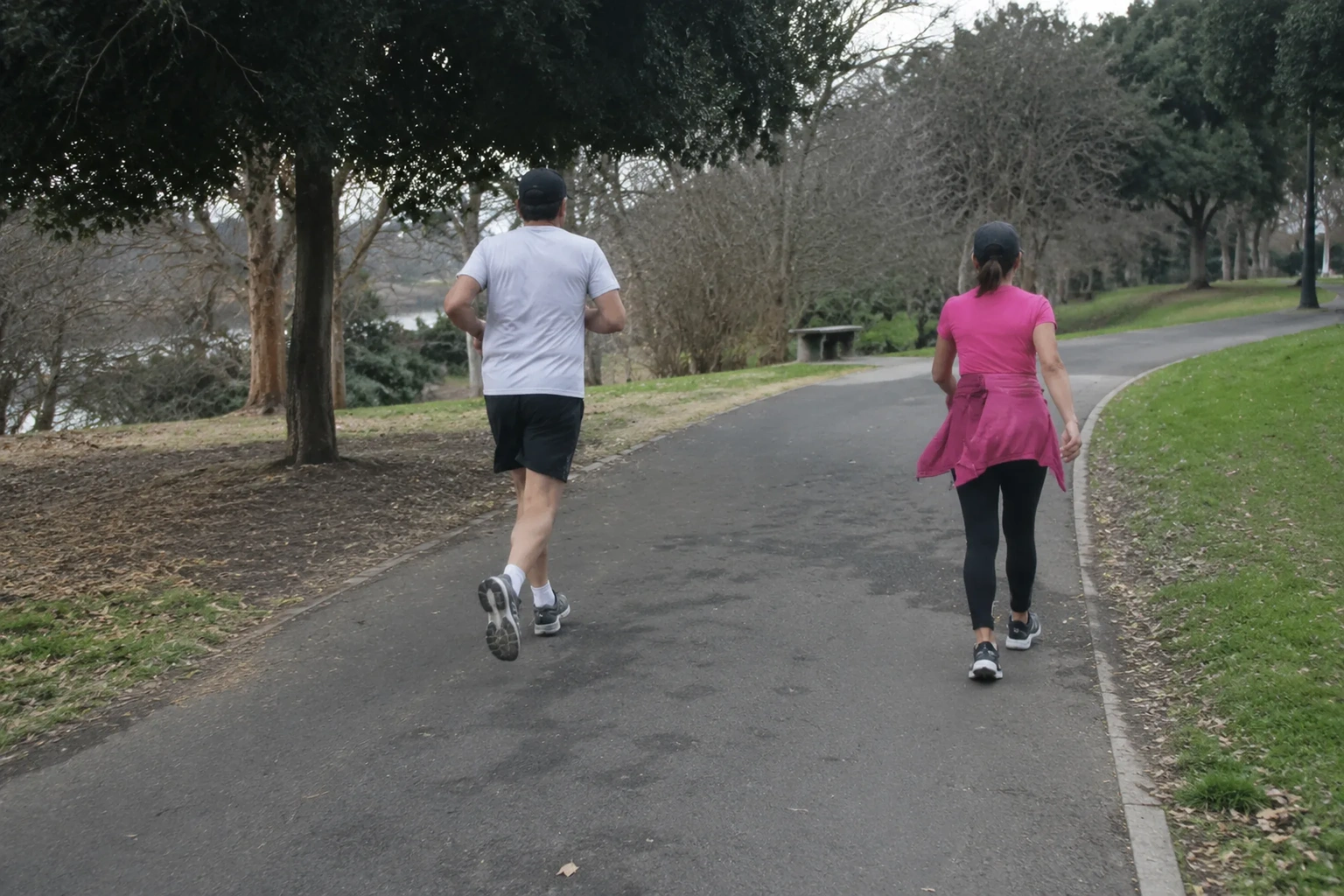
The cardiology clinic waiting room is an odd place to think about gait. Rows of chairs, a muted television, a stack of old magazines. Somewhere behind the door, a treadmill waits with its wires and its sticky electrodes. The people who end up on it are usually there because a doctor wants a number: how fast the heart beats under load, how quickly it settles, whether anything alarming appears on the tracing. What the treadmill cannot measure is whether the person on it will still be using it in six months.
Walking and running both raise the heart rate, both burn calories, both belong to the same broad family of aerobic exercise. The choice between them gets argued with a fervor that suggests the stakes are enormous. They are not, in the short term. In the long term, the stakes are enormous, and they have almost nothing to do with which activity is physiologically superior. They have to do with which one a person will actually keep doing.
The mechanical difference that decides everything
A walk and a run are separated by a flight phase. In walking, at least one foot is always on the ground; the body vaults over a relatively straight leg and the center of mass rises and falls in a gentle arc. In running, there is a moment when both feet are airborne, the body drops and catches itself, and the forces through the leg can climb to several times body weight. That single difference, ground contact versus flight, explains most of the practical consequences.
Running delivers more cardiovascular stimulus per minute. A person who runs for thirty minutes covers more ground and works harder than the same person walking for thirty minutes. That efficiency is real, and it is why running has a reputation as the serious option. It is also why running punishes a body that is not ready for it.
Walking is the activity the human frame was built to tolerate for hours. The forces are lower, the recovery is faster, and the movement pattern is simple enough that most people can do it without instruction. Walking for an hour burns roughly what running for half an hour burns, and it leaves the joints and connective tissue with far less to repair.
Why the best exercise is the one that survives a bad week
Fitness advice tends to assume a stable life. The reality is a Tuesday when a meeting runs long, a Thursday when a child is sick, a Saturday when it rains sideways and the gym is forty minutes away. The activity that fits into those weeks is the one that gets done. The activity that requires a shower, a change of clothes, a specific route, and a favorable mood does not.
Walking wins this contest more often than running does, and it wins quietly. A person can walk from a parking lot, walk during a phone call, walk to a grocery store, walk a dog. The barrier to starting is a pair of shoes. Running has a higher ceiling and a higher floor; it demands more recovery, more planning, and more tolerance for discomfort.
The question worth asking about any cardio habit is not how good it is on the best day. It is how it behaves on the worst day.
The injury ledger is not symmetrical
Running injuries are common enough to be almost expected. The knee, the shin, the Achilles, the plantar fascia, the iliotibial band: a familiar list. Most are overuse complaints, the result of doing too much too soon or of a body that cannot absorb the repetitive loading. They are rarely catastrophic, but they are disruptive, and they have a way of arriving right when a routine is starting to stick.
Walking injuries exist, but they are rarer and usually milder. The lower forces mean the tissues are less likely to be pushed past their tolerance. A walker can develop blisters, sore feet, or an irritated hip, but the pattern of injury is gentler and the recovery is shorter.
This asymmetry matters most for people who are new to exercise, returning after a long break, carrying extra weight, or managing joints that have opinions. For those groups, running is a gamble and walking is a sure thing. For a seasoned runner with a long base and a careful build, the calculus shifts.
What each one does to the hours around it
A run has a long tail. There is the warm-up, the run itself, the cooldown, the shower, the laundry. A thirty-minute run can eat ninety minutes of a day once the logistics are counted. That is fine for someone with a flexible schedule and a shower at the office. It is a real obstacle for someone piecing together a commute and childcare.
A walk has a short tail. It can happen in work clothes. It can be split into two fifteen-minute pieces. It can be done in the ten minutes before dinner while the rice cooks. This flexibility is unglamorous, and it is the single biggest reason walking habits outlast running habits in ordinary lives.
There is a subtler cost to running, too. A hard run leaves a person tired in a way that can bleed into the rest of the day. A walk tends to leave people more alert than they started. For anyone whose evenings are already spoken for, that difference in residual fatigue is a genuine factor.
The vanity argument, examined honestly
Running burns more calories per minute, and that fact drives a lot of decisions. It is worth being precise about what that means. Over a week, a person who runs three times for thirty minutes and a person who walks five times for forty-five minutes may end up in a similar place, especially once appetite is accounted for. Hard exercise tends to make people hungry, and the compensation is often larger than expected.
Walking is easier to stack. A person can walk for an hour without feeling wrecked, which means the weekly volume can climb. The body adapts to walking quickly and tolerates a lot of it. That volume, sustained over months, is where the real metabolic difference lives.
Neither activity is a weight-loss strategy on its own. Both are excellent at helping a body hold onto muscle and cardiovascular fitness while other habits do the heavy lifting. The one that gets done consistently is the one that contributes.
The runner who should be walking more
There is a particular kind of runner who runs every session at the same moderate effort, never walks, and wonders why progress stalls and why something always hurts. The answer is usually that easy days are not easy enough and hard days are not hard enough. Walking is the missing piece. A brisk walk on a recovery day does more for the next hard run than a slow jog that is neither rest nor training.
Elite distance runners have known this for decades. Their weeks include long stretches of walking, especially around sessions and on recovery days. The walk is not a concession. It is part of the program.
The walker who should try running, carefully
The reverse case exists too. A person who has walked faithfully for years, who is strong and consistent, may find that walking no longer challenges the heart the way it once did. The body is efficient, and efficiency is the enemy of continued adaptation. For that person, a cautious introduction of running, or of faster walking on hills, can reopen the stimulus.
The method matters. Alternating short bouts of jogging with longer bouts of walking, sometimes called run-walk intervals, lets the body absorb the new loading gradually. A minute of jogging followed by two minutes of walking, repeated for twenty minutes, is a reasonable starting point. The ego will complain. The knees will thank the patience.
The terrain and the weather decide more than the label
A hilly walk can be harder than a flat jog. A trail run on uneven ground demands more from the ankles and hips than a road run. The label on the activity tells less than the conditions do. A person who walks briskly up a grade for forty minutes is getting a serious cardiovascular session, and a person who shuffles along a flat path at a conversational pace is getting something gentler, whatever the watch says.
Weather shifts the balance too. Running generates more heat and is more pleasant in cold air; walking is easier to sustain in heat. In a place with brutal summers, walking early or late often beats running at any hour. In a place with long winters, running keeps the body warm enough to be outside when walking would be miserable.
A practical way to choose without overthinking it
Start with the body's history. Anyone with a recent injury, a joint that flares, or a long stretch of inactivity should begin with walking and add intensity through pace and hills before adding running. Anyone who has run before, who has a base, and who misses it can return to running with a gradual build and a willingness to walk when the body asks.
Then look at the calendar. Count the realistic windows for exercise in a normal week, not the ideal week. If the windows are short and scattered, walking fits. If there is one protected hour and a shower nearby, running fits. If there is a mix, use both: run on the days with room, walk on the days without.
The final check is honesty about enjoyment. A person who dreads every run will find reasons to skip it. A person who finds walking boring will do the same. The activity that gets done is the one that is at least mildly pleasant, or at least tolerable, on a normal day.
The number on the watch is not the point
Wearables have made it easy to compare a walk and a run on a single axis, usually pace or calories, and to conclude that one is better. That comparison misses the thing that matters. A person who walks forty minutes five days a week will, over a year, accumulate more total movement than a person who runs hard twice a week and spends the rest of the time recovering on the couch.
The heart does not care about the label on the activity. It cares about the total volume of moderate effort, the occasional harder effort, and the consistency across months. Walking and running are two tools for delivering that. The person who uses the tool that fits their life will get more from it than the person who uses the more impressive tool badly.
On the treadmill in that clinic, the number that matters most is not the peak heart rate. It is whether the person comes back next week. The same is true on the sidewalk, on the trail, and on the route around the block. The best cardio is the one that is still happening in March.





















