







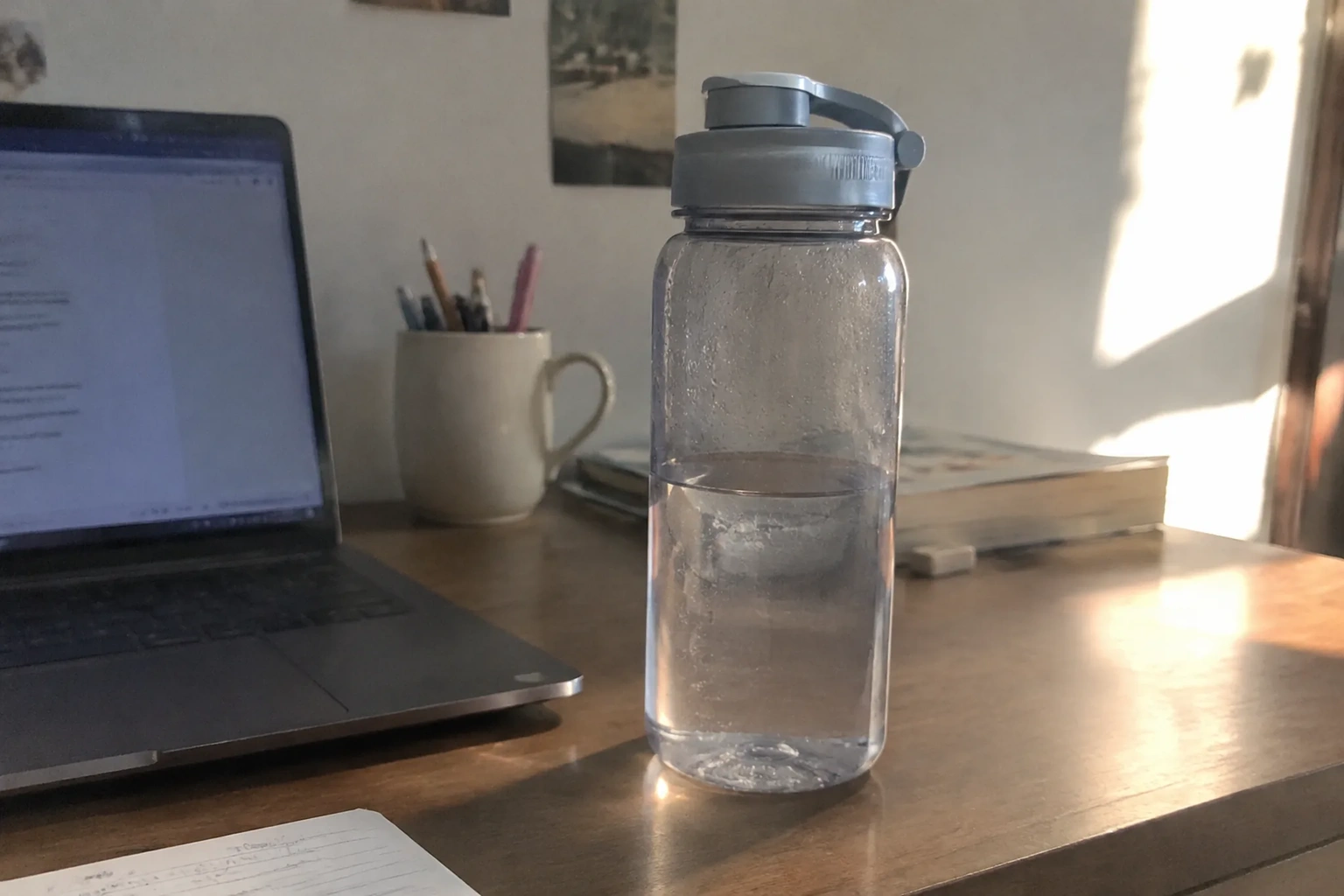
Eight glasses a day. The number has the ring of scripture, and it survives mostly because nobody can find the tablet it was carved on. Hydration advice for office workers tends to arrive in that same register: earnest, vague, and weirdly moralistic, as if thirst were a character flaw. Meanwhile the actual problem sits on the desk in plain sight, a full glass going warm and flat while the afternoon drains away.
The reminders that work are not the ones that scold. They are the ones built into the furniture of the day, the small mechanical nudges that make drinking the path of least resistance. A reminder that requires remembering is not a reminder at all. It is a test, and most people fail it by two in the afternoon.
Why the Office Makes Thirst Easy to Ignore
Desk work suppresses the body's natural signals in a way that manual labor never does. Sitting still in climate-controlled air, a person loses water steadily through breath and skin without ever breaking a sweat or feeling the exertion that normally prompts a drink. The cue goes quiet while the need keeps accumulating.
Then there is the meeting problem. A glass of water before a ninety-minute call is a gamble on the call ending on time. Anyone who has sat through a quarterly review with a full bladder learns a lesson that sticks: drink less before meetings. The lesson is correct for the meeting and disastrous for the day.
Add the coffee trap. The office runs on it, and a mug in hand feels like hydration even when it is doing the opposite. Mild caffeine intake is not the dehydration villain of office legend, but the substitution is real: the coffee gets drunk, the water gets forgotten, and the mug becomes an alibi.
The Bottle That Sits in the Wrong Place
Most office hydration failures are placement failures. A water bottle buried in a bag or tucked behind a monitor is functionally absent. The successful version lives inside the field of view, within arm's reach, and it is large enough that refilling does not become a chore.
A 750-milliliter bottle is a useful size for this. It holds enough that a person is not sipping from a thimble, and it stays light enough to carry to the kitchen without resentment. Clear or translucent walls help too, because the visual cue of a low waterline works on the brain faster than any app notification. Seeing the level drop is its own reminder.
The lid matters more than people expect. A screw-top bottle that has to be unscrewed and re-tightened gets used less than a flip-top or a straw lid, because every extra motion is a small tax on a behavior that is already competing with a screen. The best lid is the one a person can open with one hand while reading an email.
Anchor Drinking to Things That Already Happen
Habit researchers talk about anchoring, and the principle is simple enough to apply without a study: attach the new behavior to something that already occurs on a reliable schedule. Office life is full of these anchors. The moment a laptop opens in the morning. The end of every meeting. The return from lunch. The three o'clock slump.
A few sips at each anchor adds up without requiring any act of will. The trick is to pick anchors that are frequent and unambiguous. "When I finish a task" is too vague. "When I stand up from my desk" is a real, physical event that happens many times a day, and it is easy to pair with a sip before walking away.
Meetings deserve their own anchor, since they are where the day's drinking most often dies. A glass of water carried into the room solves two problems at once: it makes drinking possible during the meeting, and it gives the hands something to do during the awkward silences.
The Case Against the Giant Jug
The oversized one-gallon jug has become a fixture of office hydration culture, and it deserves a word of skepticism. The jug is a performance. It announces intention loudly, it is heavy to carry, and it turns drinking into a project with a visible finish line that most people never reach before the water goes stale.
Worse, the jug encourages a binge-and-forget pattern. A person drains a third of it in a burst of virtue at eleven, then forgets it entirely until the end of the day. Steady small amounts across the hours serve the body better than a few dramatic gulps, and the smaller bottle is the tool that makes steady drinking easy.
There is also the desk-space question. A gallon jug crowds out the notebook, the mug, and the phone, and anything that makes a desk feel cluttered gets moved to the floor, where it is no longer a reminder of anything.
Water Temperature as a Practical Variable
Cold water gets drunk faster. This is not a matter of preference so much as a small piece of physiology: cool liquid is more pleasant to swallow in a stuffy office, and pleasant things get repeated. A bottle that keeps water cold for hours removes one more reason to skip it.
Insulated steel bottles hold temperature well and survive being knocked off a desk. Their drawback is weight and the fact that they hide the water level, which kills the visual cue. A clear plastic or glass bottle shows the level but lets the water go warm. The honest solution is to pick whichever failure bothers the individual less, or to keep a small insulated bottle and refill it often.
For anyone who finds plain water boring, the fix is not a sugary drink but a slice of lemon or cucumber dropped in at the start of the day. The flavor is faint, and that is fine. It exists to make the first sip appealing, and the first sip is what starts the habit.
Digital Reminders and Their Short Half-Life
Phone apps and calendar pings are the most obvious hydration tool and the least durable. A notification that fires every hour gets dismissed within three days, and once dismissed it becomes invisible, another piece of noise in a day already full of it. Reminder fatigue is real, and hydration apps are especially vulnerable to it because the stakes feel low in the moment.
If a digital reminder is used at all, fewer and better beats many and frequent. Two pings a day, at times chosen to match the actual rhythm of the workday, will survive longer than twelve. A calendar block labeled with a real task, like "refill bottle before the afternoon call," works better than a generic alert, because it carries a specific instruction instead of a vague nag.
The strongest digital trick is not a reminder at all. It is a visible cue that lives on the desk rather than the phone: a bottle with a marked time line, or a simple sticky note that says when the next refill is due. Physical cues stay in the peripheral vision and do not require unlocking anything.
Reading the Signals the Body Actually Sends
Urine color is the oldest and most reliable self-check available, and it requires no equipment beyond a glance. Pale straw is the target. Dark yellow suggests the day has gotten ahead of the drinking, and the response is a glass of water now rather than a resolution to do better tomorrow. The check is quick, private, and free.
Other signals are easy to misread. A mid-afternoon headache and a flagging attention span get blamed on screens, on poor sleep, on the meeting that ran long. Sometimes they are simply thirst wearing a disguise. A person who reaches for a second coffee at three o'clock might do better with a full glass of water and a five-minute walk, then decide about the coffee afterward.
Thirst itself is a lagging indicator. By the time the mouth feels dry, the body has been asking quietly for a while. The point of the desk-level reminders is to answer the quiet requests before they become loud ones.
The Afternoon Slump and the Water Test
Three o'clock is the hour when office hydration fails most reliably. Energy dips, the mind wanders, and the instinct is to find a snack or another coffee. Before either, a full glass of water and a short walk to the kitchen is a cheap experiment. The result is often a clearer head within twenty minutes, and sometimes the snack turns out to have been thirst in costume.
The kitchen trip itself does useful work. Standing up, walking, and refilling breaks the static posture that makes the slump worse, and it returns a person to the desk with a fresh bottle that is, once again, in the field of view. The refill is the reminder.
A Desk Setup That Drinks Without Thinking
None of this requires discipline if the setup does the work. A bottle within arm's reach, filled at the start of the day and again after lunch. A second smaller glass for the meetings that run long. A pitcher or a large bottle of water in the kitchen so the refill is never a trek. A sticky note near the monitor with two times on it, one for the morning refill and one for the afternoon.
The goal is a desk where drinking is easier than not drinking, where the water is visible, cool, and close, and where the refill happens on the way to something else. A person who sets that up will drink more without ever thinking about hydration as a task.
By the end of a week the bottle is empty by five o'clock without anyone remembering to check. That is the whole measure of a good reminder: it disappears into the day and leaves the water gone.





















