







The weekday breakfast problem is rarely about cooking skill. It is about the eleven minutes between the alarm and the door, and the fact that hunger arrives around 10:40 a.m. with a patience that has run out. A bowl of cereal solves the first problem and creates the second. A plate of eggs solves the second and creates a dish problem. Somewhere in that gap sits a small family of breakfasts that hold a person until lunch without demanding a short-order cook's morning.
The working definition here is narrow on purpose: food that can be assembled or cooked on an ordinary weekday, in under fifteen minutes of active attention, from ingredients that keep for a week or more, and that carries enough protein and fat to blunt the mid-morning crash. Sweetness is not disqualifying. Fuss is. Anything that requires a stand mixer, a rest period, or a plating decision is out.
The night-before egg that reheats better than it should
A dozen eggs can be baked in a muffin tin on Sunday night in about twenty minutes, and the resulting cups reheat in forty seconds each morning. They are not beautiful. They puff in the oven and deflate on the counter, which is fine, because nobody is photographing a Tuesday.
The texture matters more than the recipe. A cup made from whole eggs alone turns rubbery by Thursday. Whisking in a spoonful of cottage cheese or a splash of milk per egg keeps the crumb soft through the week. Add whatever is already in the refrigerator: a handful of spinach wilted first, diced ham, a scatter of sharp cheddar. Salt goes in the mix, not on top, and the oven runs at 350 degrees for roughly eighteen minutes, until the centers barely set.
Two cups with a piece of toast and a piece of fruit is a substantial plate: somewhere in the range of twenty grams of protein, which is the number that tends to separate a breakfast that holds from one that dissolves by mid-morning. The cups also travel well in a container, which matters on days when the commute eats the kitchen table.
Overnight oats, but with enough substance to count
The standard overnight oats recipe, the one that calls for half a cup of oats and a cup of milk, is a snack wearing a breakfast costume. It is also, unfairly, the version most people try first and then abandon.
The fix is ratio and add-ins. Oats absorb liquid overnight and the mixture thickens considerably, so the jar wants more liquid than instinct suggests, closer to equal parts oats and milk with a spoonful of yogurt stirred through for body. Then the part that actually keeps a person full: a tablespoon of chia or ground flax, a spoonful of peanut butter, and a small handful of nuts on top in the morning so they stay crunchy. A pinch of salt in the jar does more for the flavor than any amount of honey.
Four jars assemble in twelve minutes on a Sunday evening. By Wednesday the oats have softened into something closer to a pudding, which some people love and others find tiresome, so a mid-week flavor swap, cinnamon one day and cocoa the next, keeps the routine from turning into a chore.
Greek yogurt with the toppings kept separate
Yogurt bowls fail for one reason: everything gets mixed together the night before and by morning the granola is a paste. The solution costs one extra container. Full-fat Greek yogurt goes in the bottom, fruit and nuts go in a small side jar, and the two meet at the desk or the table.
Full-fat matters here. The nonfat tubs carry roughly the same protein but almost none of the fat, and fat is half of what makes a breakfast last. A cup of whole-milk Greek yogurt lands near seventeen grams of protein before any toppings are counted.
Frozen berries work better than fresh for this purpose, because they thaw in the container over the course of a morning and release a syrup that sweetens the yogurt without added sugar. A spoonful of toasted seeds, pumpkin or sunflower, adds a texture that keeps the bowl from feeling like dessert. The whole assembly takes ninety seconds and requires no cooking at all.
The savory toast that behaves like a meal
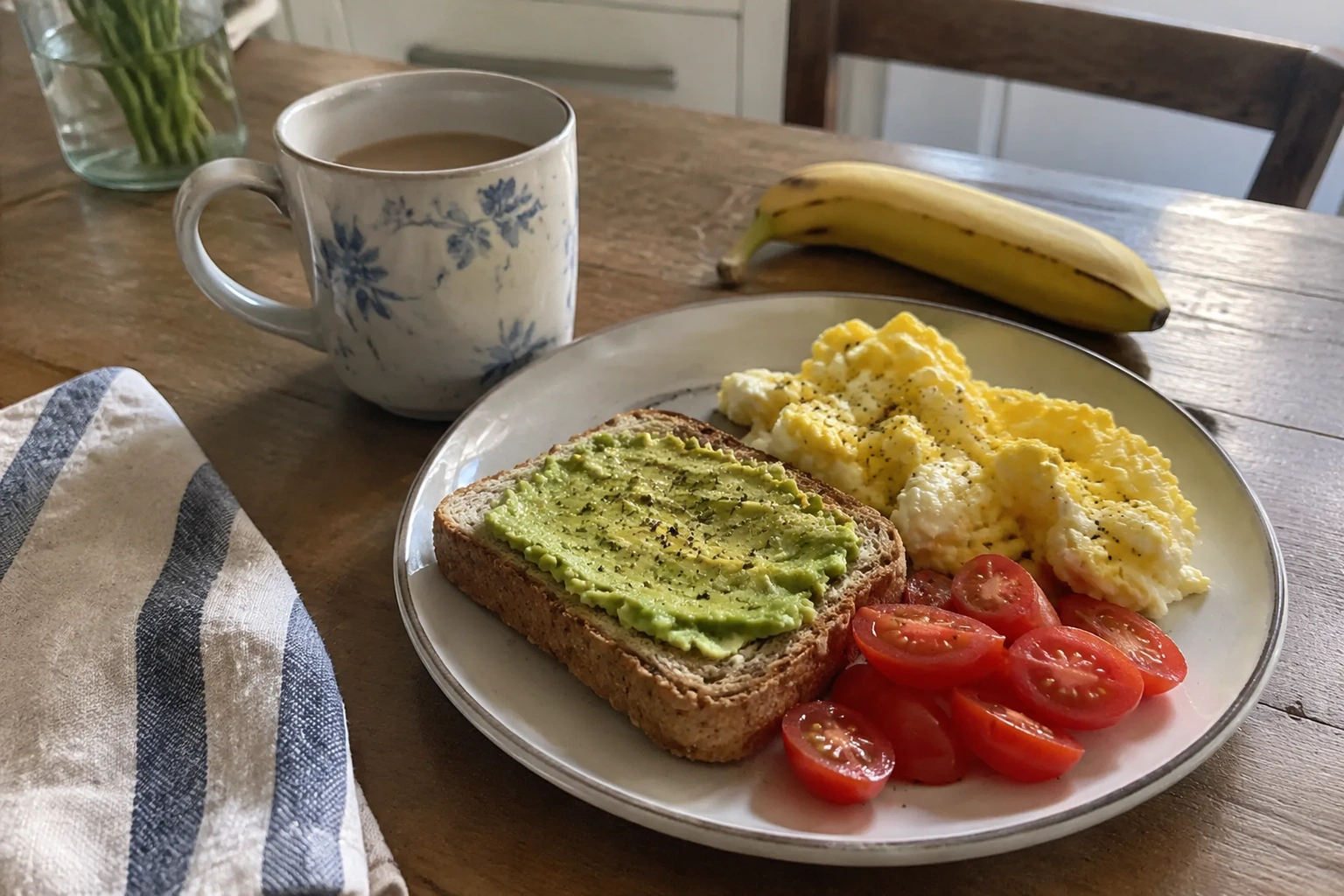
Toast gets dismissed as a light breakfast because it usually is one: a slice of bread, a smear of butter, and a cup of coffee. But bread is a delivery system, and what goes on top determines whether the morning holds. A thick slice of whole-grain bread, toasted dark, spread with mashed avocado and topped with a fried or poached egg, carries roughly the same protein load as the egg cups and takes six minutes start to finish.
The bread choice does the quiet work. A soft sandwich loaf collapses under the weight of toppings and digests quickly; a dense sourdough or seeded loaf holds up and burns more slowly. The avocado can be mashed the night before with lime and salt and stored with plastic pressed against its surface, which buys back two minutes in the morning.
For anyone tired of eggs, the same toast works with smoked salmon and a smear of cream cheese, or with ricotta, olive oil, and a hard-boiled egg sliced on top. The hard-boiled eggs can be cooked in a batch on Sunday and keep for a week in the shell.
Cottage cheese, which deserves a second look
Cottage cheese spent a decade as a diet-food punchline, and the reputation has been slow to recover. It is, however, one of the most efficient weekday breakfasts available: a half cup carries around fourteen grams of protein, it needs no cooking, and it takes savory or sweet toppings equally well.
The texture is the sticking point for most people. Small-curd cottage cheese stirred with a spoonful of olive oil and a crack of black pepper, piled onto toasted rye, and finished with sliced tomato reads as a completely different food from the watery tub eaten plain from the container. On the sweet side, a spoonful of jam and a scatter of almonds turns it into something close to a cheese danish's honest cousin.
It also keeps longer than most people expect. An unopened tub lasts well past the date on the lid, and an opened one holds for about a week if the container is kept cold and the lid is sealed.
Smoothies that are actually meals
The smoothie has a credibility problem, and it earned it. A blend of banana, juice, and ice is a glass of sugar with fiber, and it leaves a person hungry by ten. The version that works is built like a meal in liquid form.
Start with a protein base: a scoop of protein powder, a half cup of Greek yogurt, or a spoonful of peanut butter. Add frozen fruit rather than fresh, because frozen fruit thickens the blend without ice and keeps the texture from turning watery. Add a handful of spinach, which disappears entirely behind the fruit. Thin with milk rather than juice. The result carries twenty to thirty grams of protein and enough fat to slow the whole thing down.
Freezer bags assembled on Sunday, each holding a portion of frozen fruit and greens, remove the measuring step from the morning entirely. The blender runs for forty seconds. The cup goes in the car. It is the fastest breakfast on this list that still counts as food.
What all of these have in common
Every breakfast above shares three properties, and none of them is a recipe. First, protein sits at the center rather than the edge: eggs, yogurt, cottage cheese, or a scoop of powder, in quantities that reach at least fifteen grams. Second, fat is present and not apologized for, because fat slows digestion and carries flavor. Third, the assembly is either done the night before or takes under ten minutes of hands-on time.
The pattern that fails is the one most people default to under time pressure: a carbohydrate with nothing to slow it down. Cereal, a plain bagel, a granola bar, a piece of fruit eaten standing at the counter. These are not bad foods. They are simply too fast to digest to carry a morning.
The Sunday twenty minutes that buys back the week
A single twenty-minute session on Sunday evening covers most of this list. The oven heats for the egg cups while the oats soak and the freezer bags get assembled. A pot of water comes to a boil for a half dozen hard-boiled eggs. The avocado gets mashed and stored. By the time the egg cups come out of the oven, four days of breakfasts are sitting in the refrigerator, and the weekday morning has shrunk to a reheat, a stir, or a pour.
The trade is specific and small: twenty minutes on a Sunday against eleven minutes every weekday, five days running. The math favors the Sunday. The other thing the Sunday session buys is less measurable. A person who eats a real breakfast arrives at 10:40 a.m. with a clear head instead of a hunt for the office snack drawer, and the morning stops being a negotiation between hunger and the clock.





















