







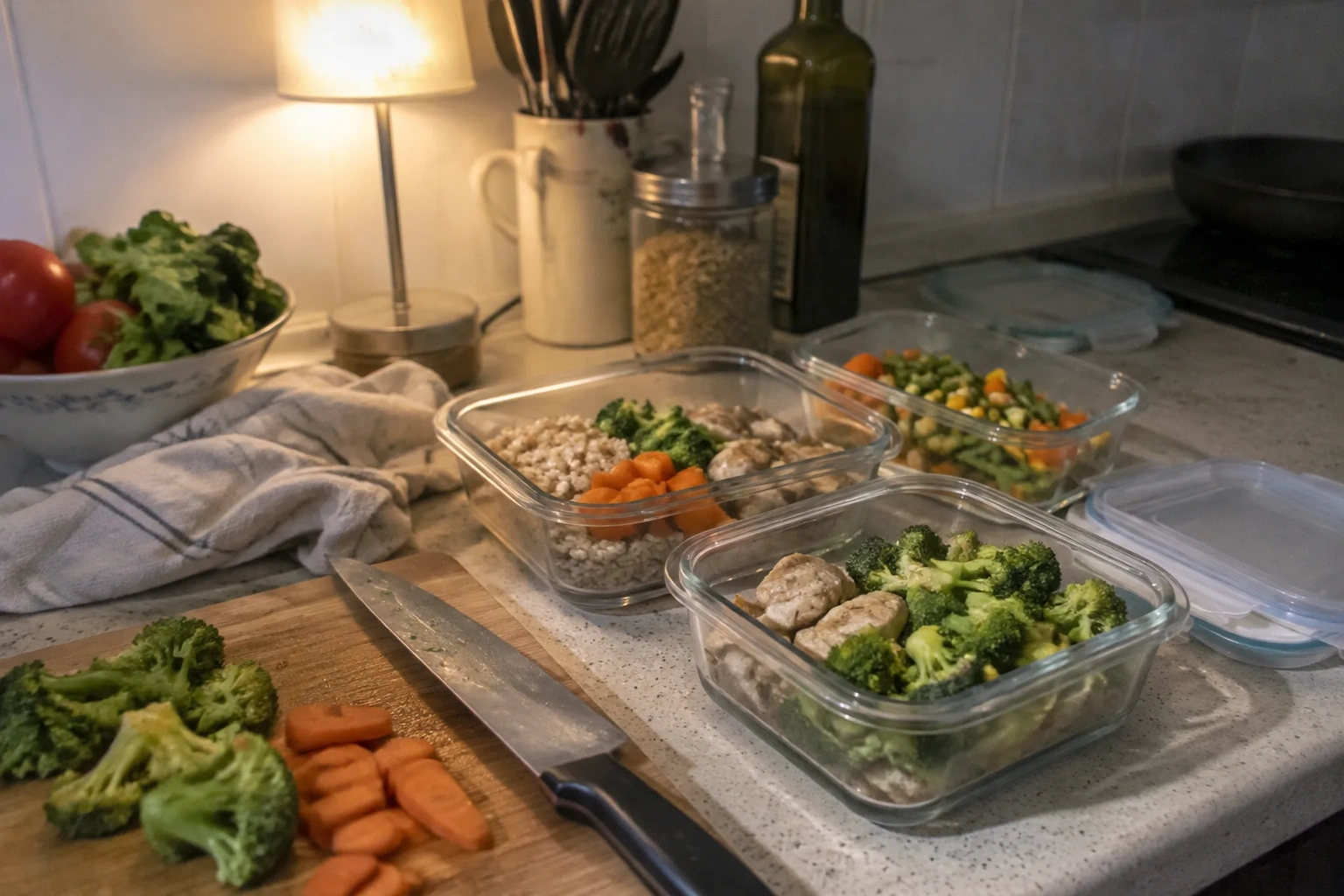
Sunday afternoon, a pot of lentils cooling on the counter, a sheet pan of chicken thighs going into the oven at 425 degrees, and a cutting board piled with onions, peppers, and carrots. This is the scene most meal-prep advice imagines. It is also the scene that makes a lot of people quit by Wednesday, because the food is fine but the plan was built for someone with a free afternoon and no Tuesday night traffic.
Weeknight meal prep works when it is small, repetitive, and slightly boring. The goal is not a week of varied, beautiful dinners. The goal is that at 6:40 on a Wednesday, after a commute and a child's tantrum and a phone call that ran long, there is something in the refrigerator that can become dinner in under twenty minutes without a decision.
The plans that fail are the ones that treat prep as cooking. The plans that hold are the ones that treat it as setup.
Cook components, not meals
A week of pre-portioned meals in identical containers sounds efficient. In practice, it means eating the same chicken and rice five times and hating it by Thursday, or worse, throwing out three of the five because the appetite for that exact combination vanished. Pre-portioned meals assume a person knows on Sunday what they will want on Friday. Nobody does.
Components sidestep the problem. A pot of plain rice, a tray of roasted vegetables, a batch of protein cooked with salt and little else, a jar of sauce or dressing. Each piece is neutral enough to be assembled differently across the week. Rice becomes a bowl with roasted vegetables and a fried egg on Monday, a side with chicken and pan sauce on Wednesday, a quick stir-fry base on Friday. The cooking is done once. The decisions are made fresh, in the moment, which is when a person actually knows what sounds good.
The components need to be genuinely plain. A chicken thigh marinated in soy, honey, and ginger commits the whole week to that flavor. A chicken thigh roasted with salt and pepper commits to nothing.
The two-hour Sunday that actually holds
Two hours is enough. Not four. Not a whole afternoon. The point is to leave the kitchen with a refrigerator that is more capable than it was, not to exhaust the one free day of the week.
A workable sequence: oven on at 425 degrees. A sheet pan of vegetables (whatever is in season, cut to roughly the same size, tossed with oil and salt) goes in first because it takes the longest, thirty to forty minutes. While that roasts, a pot of rice or farro goes on the stove. A second sheet pan of chicken thighs or a pot of lentils or a tray of meatballs follows. A jar of vinaigrette gets shaken together in thirty seconds. A pot of beans, if using dried, has been soaking since morning or is skipped in favor of canned.
That is it. Rice, roasted vegetables, one protein, dressing, beans. Four or five containers in the refrigerator by the end of the second hour, and the kitchen is not destroyed because nothing was elaborate.
The sequence matters less than the constraint. Two hours, one oven, no recipes with more than six ingredients. The moment a plan requires a trip to a specialty store or a technique that has never been attempted on a weeknight, it is a weekend project wearing a weeknight costume.
What to buy on Saturday so Sunday stays short
The two-hour Sunday only works if the shopping is already done. A person who starts prep at 4 p.m. on Sunday without groceries will spend the first forty minutes in a car and the next twenty in a checkout line, and the whole plan collapses.
A short, repetitive list does the job. Two proteins (chicken thighs and either lentils or ground meat), one grain (rice, farro, or pasta), three or four vegetables that roast well (onions, peppers, carrots, broccoli, sweet potatoes), a jar of something acidic (pickles, olives, capers), a block of cheese, eggs, and whatever sauce or dressing ingredients are already in the pantry. That list is not exciting. It is also not a trap.
The trap is buying for variety. Seven different dinners require seven different shopping lists and seven different prep sessions. A refrigerator stocked with four components and a few jars of flavor can produce more genuinely different meals than a refrigerator stocked with seven pre-portioned containers, because the person assembling dinner on Wednesday has options instead of obligations.
The Wednesday problem
Every weeknight meal plan meets the same wall around Wednesday. The components are still in the refrigerator, but the enthusiasm has drained. This is the night takeout wins, and it wins because the components feel like homework.
The fix is a single planned interruption. One night a week, dinner is deliberately not from the prep containers. It might be eggs and toast, a frozen pizza with a bag of salad, or a rotisserie chicken picked up on the way home. Building that night into the plan removes the guilt that otherwise compounds by Thursday and turns a small slip into an abandoned week.
A second fix is to keep one component that requires no assembly. A pot of soup or chili frozen in single portions, thawed on Wednesday morning, is dinner that requires reheating and nothing else. The person who plans for the Wednesday collapse is the person whose plan survives it.
Storage that does not punish the cook
Clear containers matter more than they should. A refrigerator full of opaque containers is a refrigerator full of mystery, and mystery gets skipped in favor of takeout. Glass containers with visible contents, stacked by category, let a person open the door and see dinner instead of guessing at it.
The other storage rule is to keep components separate until the moment of eating. Roasted vegetables stored in the same container as rice turn the rice soggy by day three. Chicken stored with its sauce gets rubbery. Separate containers cost a few more dishes and preserve the components for the full week.
Labels are optional. A piece of masking tape with the day of cooking written on it is enough to prevent the Friday gamble of not knowing whether the lentils are three days old or six.
A twenty-minute assembly rule
The whole system rests on one number: twenty minutes from refrigerator to table. If assembly takes longer than that, the plan has failed, because the nights that need meal prep are not nights with thirty-five minutes to spare.
Twenty minutes is achievable when the components are already cooked. A bowl of rice, a handful of roasted vegetables, a protein, and a spoonful of dressing takes four minutes. A quick sauté of leftover vegetables with a fried egg on top takes eight. A pot of pasta with a jar of sauce and a handful of the prepped vegetables takes fifteen. The cooking that happens on a weeknight is reheating and assembling, and the actual flavor work was done on Sunday.
The twenty-minute rule also disciplines the Sunday prep. A component that cannot be turned into dinner in twenty minutes on a Wednesday was not worth prepping. That standard quietly eliminates the fussy components and leaves the ones that actually get eaten.
Why the smaller plan wins
There is a version of meal prep that looks like a cooking show: seven beautiful, distinct dinners, each in its own labeled container, photographed on a marble counter. That version is a hobby. It is a fine hobby, and the people who do it well are genuinely impressive. It is also not the version that survives a real week.
The version that survives is smaller and less photogenic. Four components, one interruption night, clear containers, a twenty-minute ceiling on assembly. It looks like a refrigerator with a pot of rice, a tray of roasted carrots, a container of chicken thighs, and a jar of dressing, and it produces a week of dinners that are different enough, fast enough, and low-stress enough that a person actually cooks them instead of ordering in.
By Friday, the containers are empty, the kitchen is not a disaster, and the plan did its only real job: it made the weeknight version of dinner possible on a day that did not feel possible.





















