







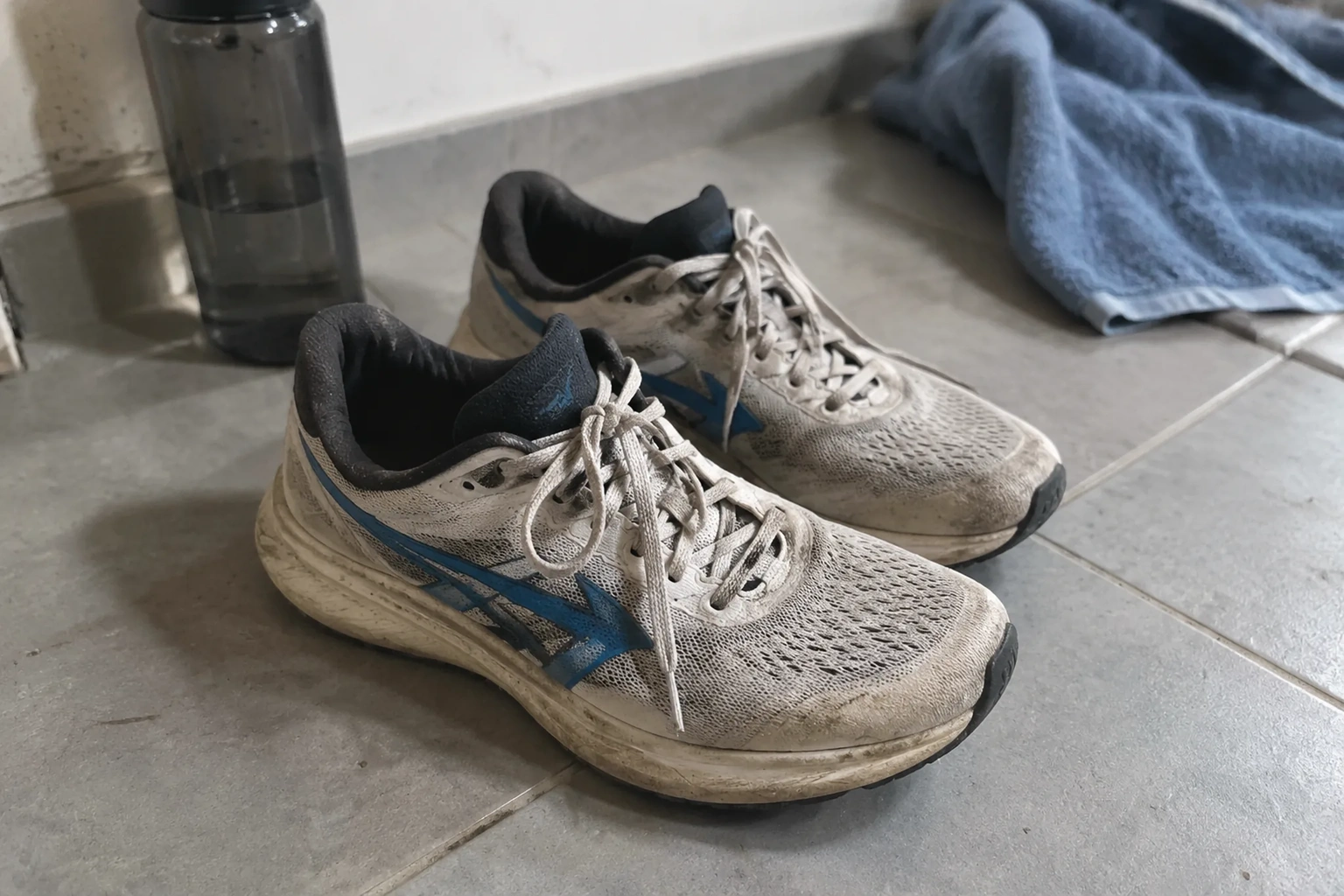
The wall of running shoes in a specialty store runs forty feet, floor to ceiling, and every pair is trying to solve a problem the first-time buyer does not yet have. Cushioning for pronation. Plates for speed. Foam densities with names that sound like aircraft materials. A person who has decided to start running, who has maybe jogged three times in old gym shoes and felt a twinge in the knee, stands in front of that wall and quietly panics. The salesperson asks a question about gait and mileage, and the honest answer is: no idea, and none yet.
The strange thing about the running shoe market is that it is designed for people already running. The beginner is an afterthought, sold either the cheapest neutral shoe on the shelf or something wildly overbuilt because it looked serious. A first pair of running shoes has one job, and it is narrower than the industry implies: it needs to let a new runner keep running without getting hurt or quitting out of discomfort. Everything else is decoration.
The shoe that fits a foot at rest is not the shoe that fits a foot in motion
Most people buy shoes by standing in them. The heel feels snug, the toe has a little room, the arch is not pinching. For walking to the mailbox this method works fine. For running it fails, because a running foot does something a standing foot does not: it slides forward and swells. After a mile, the foot has spread and lengthened, and the shoe that felt perfect in the store starts pressing the longest toe against the front.
The fix is unglamorous. Try shoes on late in the day, when feet are already slightly swollen, and leave a thumb's width between the longest toe and the inside of the toe box. Not half a thumb. A full one, roughly the width of a thumb across the nail. This feels wrong to almost everyone at first, because a shoe with that much room seems to be sliding around. It is not. A running shoe is allowed to be roomy in front and snug at the heel and midfoot, and that combination is what keeps the toes from bruising on downhills.
The heel, meanwhile, should lock without being crushed. A common beginner mistake is to lace the whole shoe tight to stop slippage, which strangles the top of the foot and numbs the toes within a mile. Better to leave the lower laces relaxed and use the top eyelets to pin the heel. Most running shoes have an extra eyelet pair near the ankle designed for exactly this, and most buyers never touch it.
Cushioning is a preference, not a prescription
The marketing around running shoes has convinced a generation that cushioning levels must be matched to body weight, stride, and some diagnostic number printed on a treadmill report. There is truth in the middle of that, but the edges are softer than the industry admits. A 130-pound runner and a 210-pound runner may both be perfectly happy in the same neutral shoe, or may not. The body adapts, and the cushioning that feels right is largely a matter of personal tolerance built up over weeks.
For a first pair, the safe zone is moderate. A maximal shoe with a stack height that looks like a mattress will feel strange and unstable to someone who has not yet developed the ankle strength to manage it. A racing flat with almost no foam will feel harsh and will punish mistakes in form. The middle of the range, a daily trainer with a reasonable slab of foam and a bit of firmness, is where most beginners should start. It is the beige sedan of running shoes, and beige sedans are excellent first cars.
Foam type matters less than foam condition. A shoe that has been sitting in a warehouse for three years, or one bought secondhand and already compressed under someone else's stride, is not the bargain it appears to be. Foam degrades. A fresh pair of mid-tier shoes outperforms a tired pair of premium ones every time.
The pronation question is smaller than the fitting question
Every beginner eventually hears the word pronation and assumes it is a diagnosis. The foot rolls inward slightly on landing, which is normal and necessary, a way of absorbing force. Some feet roll more than others. The shoe industry has built an entire category, the stability shoe, around correcting the over-rollers, and for a subset of runners with significant overpronation and a history of related discomfort, that category helps.
For most first-time runners, though, the fitting matters more than the category. A person who has never run consistently does not yet know whether the foot rolls too much, because the gait changes as fitness and strength improve. Buying an aggressive stability shoe on day one is like buying orthotics before the injury. Start with a neutral shoe. If persistent discomfort develops over months of running, address it then, ideally with a professional who can actually watch the stride.
There is a real cost to getting this wrong in the other direction, too. A runner who genuinely needs stability and buys a soft neutral shoe may end up sore in the shins or knees, and will blame running itself rather than the shoe. The signal is not subtle: pain that recurs in the same place after most runs, rather than general muscle fatigue that fades. That pattern is worth taking to a running store or a physio, not to a forum thread.
A store that watches a stride is worth the extra twenty dollars
Online shoe shopping is cheaper and easier, and for a second or third pair it is fine. For the first pair, a specialty running store earns its markup, not because the staff are wizards but because they will watch a person jog down the sidewalk and say something useful. Even a crude gait observation catches the obvious cases: a heavy heel strike, a foot that collapses inward dramatically, a stride that looks pained rather than awkward.
The good stores also have a return policy that lets a buyer run in the shoes for a week or two and bring them back if they cause trouble. This is the single most valuable thing a first-time buyer can get, more valuable than any foam technology. Shoes are personal, and the only real test is miles. A store that stands behind a pair after they have been sweat in is a store worth the trip.
What the staff cannot do is make the decision. The shoes have to feel right on the actual foot, and no amount of expertise on the other side of the counter substitutes for a few laps around the block. Take the time. Jog, do not walk. Walk in a running shoe and it will feel clunky and overbuilt. Run in it and the geometry makes sense.
Rotating two cheap pairs beats wearing out one expensive pair
The standard advice to replace running shoes every few hundred miles is roughly true and almost useless to a beginner who has no idea how to track miles. A simpler rule: when the midsole starts to feel flat and the shoe no longer bounces back after a run, it is done. For most people that lands somewhere between a few hundred and five hundred miles, depending on weight, surface, and how much the shoe sat in a hot car.
The better beginner strategy is to buy two pairs of a solid mid-tier shoe and alternate them. Foam recovers between runs, so a shoe worn every other day lasts longer than twice as long as a shoe worn daily. Two modest pairs also let a runner compare and learn what actually feels good, which is information no review can supply.
This is also where the beginner's budget should be honest. A first pair does not need to cost the price of a good dinner for four. The premium shoes are premium because of racing technology, not because they are safer or better for a new runner. A hundred and twenty dollars spent on a sensible daily trainer, or two hundred and forty on two of them, will carry a person through the first year of running better than a single four-hundred-dollar pair of carbon-plated racers that will be wrong for most training days anyway.
The shoe store is not the only thing to bring
Buying the right shoes is the beginning, not the whole equipment problem. The socks matter more than most beginners expect. Cotton socks hold sweat against the skin and create friction, and friction over an hour of running produces blisters that end more running careers than bad foam ever has. A few pairs of synthetic or wool running socks, thin and seam-free, cost little and eliminate a whole category of misery.
The other thing to bring to the first purchase is patience with the awkwardness. New running shoes feel strange for the first few runs. The foot has to relearn how to land, the ankle has to strengthen, and the shoe itself needs a break-in period of maybe ten miles before the foam and upper settle. A person who judges a shoe on the first mile will return a perfectly good pair and start over with something worse.
Give the first pair two weeks of honest running, three or four times a week, before deciding anything. If the shoes are still causing trouble after that, if a specific spot on the foot or shin keeps complaining, then the shoe is wrong and the store's return policy is the tool to use. If the shoes have quietly disappeared from awareness, if the runner stops thinking about feet at all and starts thinking about the route, the shoes are right.
That forgetting is the entire goal. A good first running shoe is the one a person stops noticing, the one that lets the mind drift to the weather and the pace and the song stuck in the head. The wall of forty feet of shoes is trying to sell attention. The right pair earns none.





















