







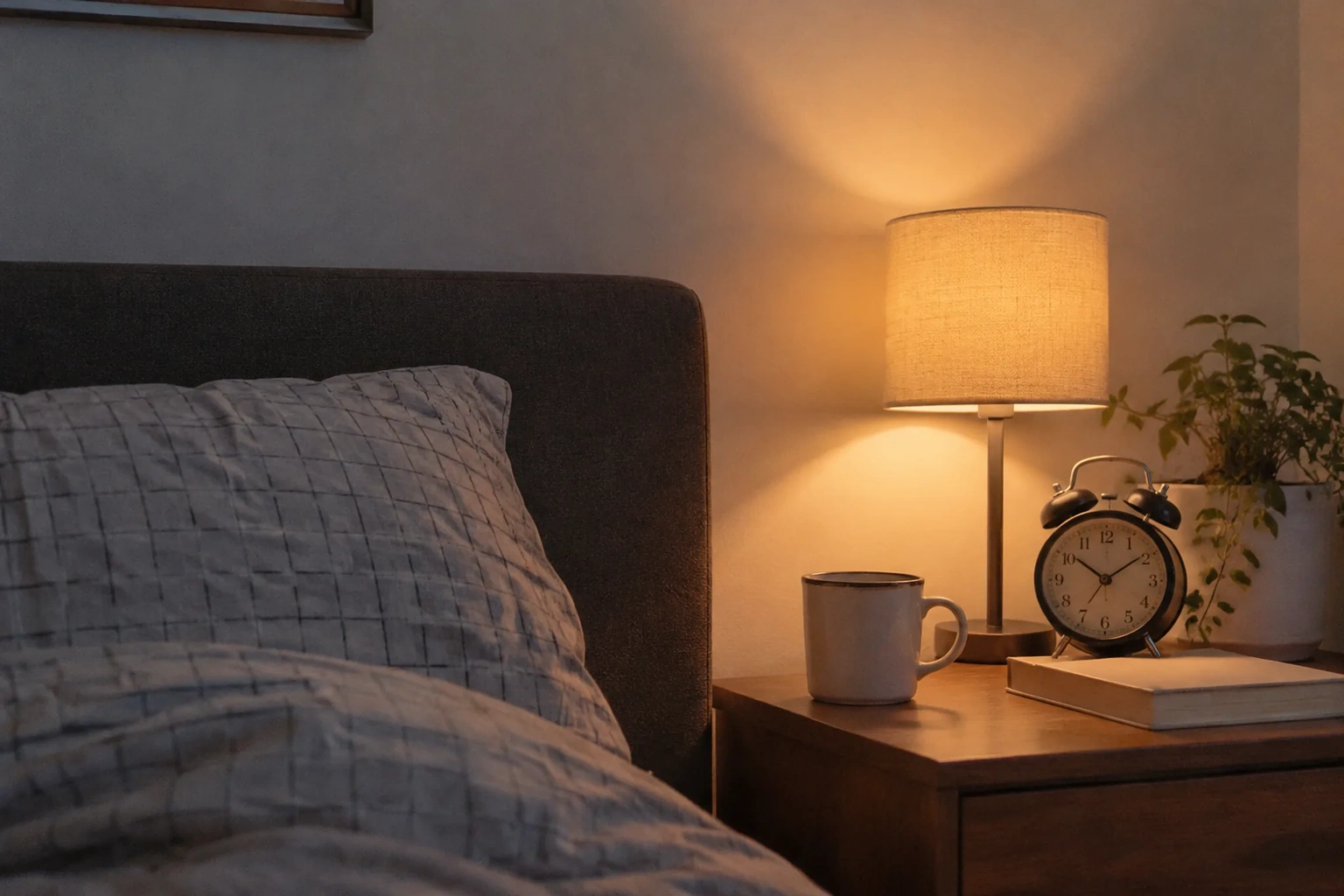
The best evening routines look boring from the outside. A dish towel folded over the oven handle. A phone face-down in a drawer. One lamp switched off at the same hour, night after night. The work of winding down is mostly subtraction, and subtraction has no drama to it. That is why so few people actually do it.
Most adults know the general shape of good sleep hygiene the way they know the general shape of a balanced diet: vaguely, and without much obedience. The advice tends to arrive as a list of prohibitions, which is a hard way to build a habit. A routine that survives a Tuesday in February has to be made of small physical acts, not rules. It has to feel like a place to arrive at, not a checklist to fail.
The case for an evening routine rests on something plain. The body runs on cues, and sleep arrives more easily when the hour before it is recognizably the same as the hour before it was yesterday. Consistency does the heavy lifting. The specific ritual matters less than the repetition, which is encouraging news for anyone who has tried an elaborate routine and abandoned it by week two.
The Hour Before the Hour
Start with the timing, because the timing is where most routines quietly collapse. The wind-down does not begin when a person climbs into bed. It begins roughly ninety minutes before the intended lights-out, and the first move is a change of light.
Overhead bulbs are the enemy of that change. A single living-room ceiling light at full brightness tells the brain it is midday regardless of what the clock says. The fix is cheap and mechanical: after dinner, keep the overheads off and turn on two or three lamps with warm bulbs, placed low. The room dims without going dark. The shift is obvious in the first week, and it costs nothing.
There is an argument for doing this earlier than feels necessary. A home that dims at eight in the evening is telling everyone in it something before anyone has to say a word. The cue does the persuading. Households with children tend to discover this by accident; households without them can adopt it on purpose.
A Kitchen That Closes
Kitchen cleanup belongs inside the routine, not outside it as a chore. Wiping the counters, loading the dishwasher, and setting the coffee for the morning are a sequence with a beginning and an end, and that shape is useful. A person who finishes the kitchen at nine and walks into a dark, clean room has already accomplished something the night will reward.
The coffee setup is worth keeping even for people who do not drink coffee at home. It marks the end of the day's decisions. The next morning is planned; nothing more is required tonight. Small forward gestures like this buy a kind of calm that no meditation app can sell.
Eating late is the other kitchen issue. A full meal at ten in the evening sits in the stomach for hours, and lying down on top of it rarely produces restful sleep. A lighter habit helps: dinner by seven, and if hunger returns, something small and plain around nine. The point is less about rules than about not asking the body to digest while it is trying to do something else.
Where the Phone Goes at Nine
Every public conversation about winding down eventually reaches the phone, and the usual advice is to put it away an hour before bed. Nearly no one does this. The advice fails because it asks for a clean break at the exact moment the phone is most tempting.
A more practical version is a destination rather than a deadline. The phone charges in the kitchen or the hallway, on a cable, face-down, from nine in the evening until the morning alarm. A phone that lives in another room does not have to be resisted. It simply is not there.
The first nights feel wrong. The hand reaches for a pocket that is empty, and the absence is loud. By the fifth night the reach stops. The reward is not moral purity; it is the discovery that the last hour of the day is longer than it used to be, and quieter, and belongs to the person living it.
An alarm clock on the nightstand covers the one real function the phone was serving in the bedroom. The older ones are best: a dial, a red display, no settings menu to fall into at midnight.
The Case for the Bathroom as Ritual
The bathroom holds the most reliable cues of the evening, and most people already run half of them without noticing. A shower, teeth brushed, face washed, pajamas on. Each step is a small bright signal that the day is closing. The trick is to run them in the same order every night, at roughly the same time, with a little more care than strictly necessary.
A warm shower about an hour before bed does something useful with body temperature. The warmth of the water is followed by a slow cool-down afterward, and that downward drift is one of the body's natural sleep signals. The shower does not need to be long. Ten minutes, same time each night, is plenty.
Then the small tools: a toothbrush, a plain moisturizer, a comb. Any of these can become the anchor of the routine, the fixed point every other step orbits. People who travel a lot know this, and pack the same three items in a bag that goes everywhere. The bag is the routine in miniature.
Ten Pages, One Lamp, No Screen
Reading before sleep is the oldest wind-down there is, and it still works. The reason is the paper. A book does not glow, does not buzz, does not invite a reply. It requires a lamp, which means the room has to be otherwise dark, which means the reading itself is a small act of turning inward.
The choice of book matters more than people expect. A thriller that keeps a reader awake until two in the morning is a poor wind-down tool, however enjoyable. Something dense and slightly slow is better. A book of essays, a biography, a history of a place. The goal is to read until the page stops making sense, then close the book and turn off the lamp. Falling asleep mid-paragraph is a success, not a failure.
Ten pages is a useful target. It is short enough to attempt on a tired night and long enough to pull the mind out of the day's loops. Some nights it will be three pages. Some nights it will be twenty. The number is not the point. The lamp and the closed book are the point.
The Room Itself
Bedrooms tend to accumulate everything the rest of the house has run out of room for. A chair piled with clothes, a desk with papers, a stack of boxes in the corner. Each object is a small unfinished thing, and unfinished things are not restful to lie down among.
Five minutes with a laundry basket on a Sunday can clear a bedroom of most of its clutter, and the change in how the room feels at night is out of proportion to the effort. Cool, dark, and quiet remain the three properties worth protecting. Blackout curtains for the first. A door closed against the hallway for the second. Earplugs if the street outside is loud. These are unglamorous purchases that pay every single night.
The bed itself does not need much. A mattress that is comfortable, a pillow that holds its shape, sheets that are clean. An expensive duvet adds less than most people believe. What matters is that the bed is reserved for sleeping, and that the room around it is calm when the lights go out.
What to Do When Sleep Will Not Come
Some nights the routine runs perfectly and sleep still refuses. Half an hour passes, then an hour. The temptation is to lie there and calculate how many hours remain before the alarm, which is the least helpful thing a mind can do.
Getting up is better. A dim lamp, a chair, a book, and no clock in sight. Read until drowsy, then return to bed. The point is to break the association between the bed and the frustration of not sleeping, so that the bed stays a place where sleep happens. A person who does this twice a month will barely notice it. A person who does it nightly has a different problem, and one worth taking to a doctor.
An occasional bad night is normal. A run of them is information. Persistent difficulty falling or staying asleep is worth a conversation with a physician, and the conversation should come before the elaborate supplements and the expensive gadgets.
The Same Lamp, Off at Ten
A routine becomes real when it survives a bad day. The meeting that ran long, the dinner that went late, the child who would not settle. On those nights the full sequence falls apart, and the people who keep the routine anyway do it by keeping the smallest piece. The lamp, the phone in the kitchen, the ten pages.
That is the argument for making the routine small in the first place. A wind-down that takes twenty minutes and asks almost nothing of a tired person is one that can be repeated for years. The reward is not a perfect night's sleep. It is the ordinary one, arriving on schedule, in a room that has been quietly prepared for it.
Ten o'clock. One lamp still burning in the living room, the book open on the arm of the chair, the phone asleep in the kitchen. The house dims, the day closes, and the last hour belongs to whoever is still awake to spend it.





















