







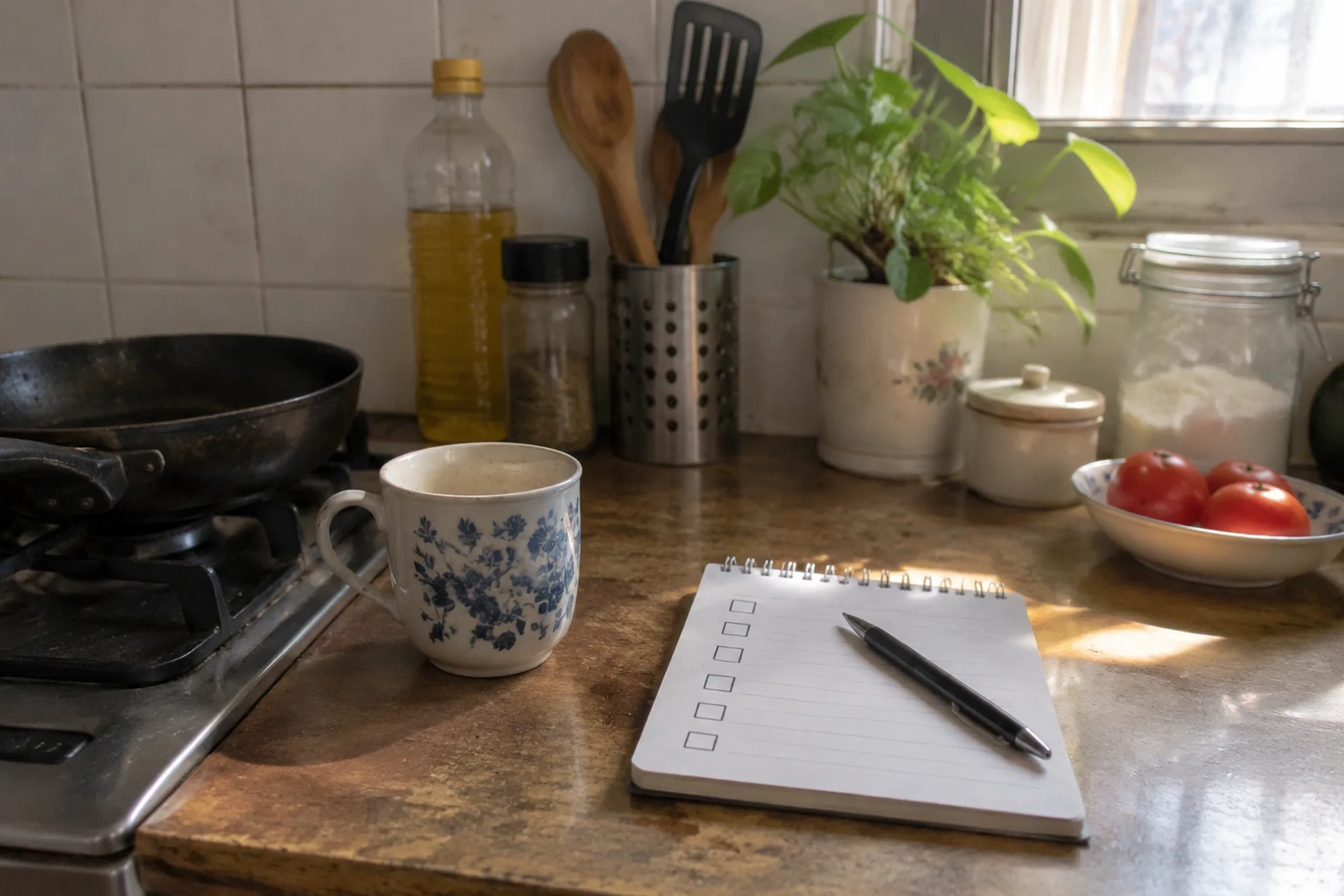
The registry list for a first kitchen has become a strange document, half practical inventory and half anxiety translated into stainless steel. Somewhere between the stand mixer and the sous-vide circulator, the actual business of cooking dinner disappears. A sensible starter kitchen is a smaller, duller thing than the catalogs suggest, and it is built around a handful of decisions that a person will keep making for years.
What follows is a checklist, but a checklist with opinions. The goal is a kitchen that can produce a weeknight meal, a weekend project, and a batch of cookies without a trip to the store, assembled for roughly the cost of one mid-range appliance.
The three knives that cover nearly everything
Knife sets are a trap. A block of eight blades usually contains two that get used and six that gather dust and take up counter space. Three knives do the work of the block: a chef's knife with an 8-inch blade, a serrated bread knife, and a small paring knife.
The chef's knife is the workhorse. It breaks down a chicken, minces garlic, slices an onion, and crushes a clove under the flat of the blade. An 8-inch blade suits most hands; anyone with small hands may prefer 6 inches, and anyone breaking down large cuts will want 10. The shape matters less than the weight and the balance at the bolster, the thick collar where blade meets handle.
The serrated knife exists for bread and tomatoes, and it does both better than a chef's knife will. A 9- or 10-inch offset or straight blade is fine. The paring knife handles the small work: hulling strawberries, peeling apples, trimming green beans. It should feel like an extension of the fingers, not a miniature chef's knife.
Spending money here pays off in a way it rarely does elsewhere. A $40 chef's knife from a restaurant supply store will outperform a $150 knife from a department store display. The steel holds an edge, the handle survives the dishwasher's steam, and the blade can be sharpened for decades. Buy one good knife before buying three mediocre ones.
The cutting board question, settled by weight
A cutting board that slides across the counter is dangerous, and thin plastic boards slide. The fix is mass. A thick wooden board, maple or beech, at least an inch and a half thick, stays put through a session of chopping and gives a knife edge something forgiving to bite into. It needs oiling every few months and should never sit in a sink full of water.
Plastic has its place for raw meat, where the board can go into the dishwasher and come out clean. Two thin plastic sheets, one reserved for poultry and fish, cost almost nothing and can be stored behind the wooden board. The wooden board handles vegetables, bread, and everything else.
Skip the glass boards. They dull knives quickly, they are loud, and they are slippery when wet. A glass board is the single most common starter-kitchen mistake, and it is an easy one to avoid.
Pans: one skillet, one pot, one sheet pan
A 10- or 12-inch skillet with a heavy base is the first pan to buy. Cast iron is cheap, lasts forever, and can go from stovetop to oven, though it needs seasoning and does not react well to acidic sauces. A clad stainless skillet costs more and handles everything, including pan sauces, without the maintenance. Either works. What does not work is the thin nonstick pan that warps after a year and sheds its coating into the eggs.
Nonstick has one legitimate job in a starter kitchen: eggs. A single 8-inch nonstick pan, replaced when the surface starts to scratch, is enough. The rest of the cooking happens on cast iron or stainless.
The pot is a 4- to 6-quart Dutch oven or a heavy-bottomed saucepan with a lid. It boils pasta, simmers beans, braises a pork shoulder, and makes rice. A Dutch oven in enameled cast iron is the more versatile choice, since it moves from stovetop to oven without complaint. A lighter stainless pot is easier to lift and cheaper; the tradeoff is uneven heat on the stovetop.
The sheet pan is the third piece, and it is the one that gets overlooked. A half-sheet pan, roughly 18 by 13 inches, with a rim, roasts vegetables, bakes cookies, and catches drips under a pie. Buy two. They nest, they cost less than a skillet, and they will be in use more often than anything else in the cupboard.
The small tools that earn their drawer space
A short list of hand tools covers the gaps: a wooden spoon or two, a silicone spatula that can scrape a bowl clean and survive a hot pan, a pair of tongs with a locking mechanism, a whisk, a colander, and a set of nested mixing bowls. A digital instant-read thermometer is the one piece of technology worth adding early. It turns guesswork about chicken and pork into a number, and it costs less than a decent bottle of wine.
A kitchen scale is the other quiet upgrade. Baking rewards weight over volume, and a $25 scale makes a batch of bread or cookies repeatable in a way that cups and spoons never will.
The tools that get skipped: a garlic press (a knife does the job), an avocado slicer, a banana slicer, a strawberry huller, a set of twelve measuring spoons in novelty shapes. Every one of these is a solution to a problem that does not exist, and each one takes up space that a second spatula could use.
Storage containers, matched to the pantry
Containers are where starter kitchens quietly go wrong. A person buys a set of fifteen nesting boxes in three sizes, and within a month the lids are lost and the large boxes hold a single leftover chicken thigh. The better approach is to buy a few containers in two sizes, square and stackable, with lids that snap rather than press. Square shapes waste less shelf space than round ones.
Glass containers are heavier and more expensive, but they do not stain from tomato sauce and they can go from fridge to oven. A starter set of three or four glass containers plus a handful of inexpensive plastic ones for dry goods covers most needs.
The pantry itself needs very little: salt, pepper, a neutral oil for high heat, olive oil for finishing, and a few dried spices that get used. A spice rack with twenty jars is decoration. A person cooks with five spices regularly and the rest sit until they lose their flavor. Buy small quantities, refill as needed.
What to leave off the list entirely
The stand mixer is the most common aspirational purchase in a first kitchen, and it is also the most likely to sit unused. It earns its counter space for someone who bakes bread weekly or makes cakes for a living. For everyone else, a hand mixer at a fraction of the price does the same job and stores in a drawer.
The same logic applies to the food processor, the air fryer, the Instant Pot, and the sous-vide circulator. Each is a single-purpose machine that solves a specific problem. None of them is necessary to cook well. A person who cooks for a year and finds a recurring need can buy the machine then, with a clear sense of what it will actually do.
The exception worth considering is a blender, and only if smoothies or soups are a regular habit. A basic blender with a glass jar handles both. The high-powered models are impressive, but they cost as much as the rest of the starter kitchen combined.
The order of buying, if the budget is tight
Most people do not buy a kitchen in one trip. They accumulate it over months, adding pieces as needs appear. That is the right instinct, and a rough order helps.
First, the chef's knife and the cutting board. Without them, nothing else matters. Second, the skillet and the saucepan. Third, the sheet pan and the small tools. Fourth, storage containers and pantry staples. Fifth, the thermometer and the scale. Everything else waits until a specific need shows up.
This order has a logic: the first two purchases make cooking possible, the next two make it varied, and the rest make it convenient. A person who owns a good knife, a board, a skillet, and a pot can cook most of what they will ever want to eat. The rest of the list is refinement.
A test for any future purchase
Before buying anything for the kitchen, a simple question helps: what will this replace, and how often will it be used? A tool that replaces a knife and gets used weekly earns its place. A tool that replaces nothing and gets used twice a year does not.
The starter kitchen is not a smaller version of a professional kitchen. It is a set of tools chosen for the way a real person cooks, which is to say unevenly, in bursts, with a few dishes repeated until they become second nature. The checklist above is built for that reality, and it leaves room for the one appliance or gadget that a particular cook will genuinely use. That is the only customization a starter kitchen needs.





















