







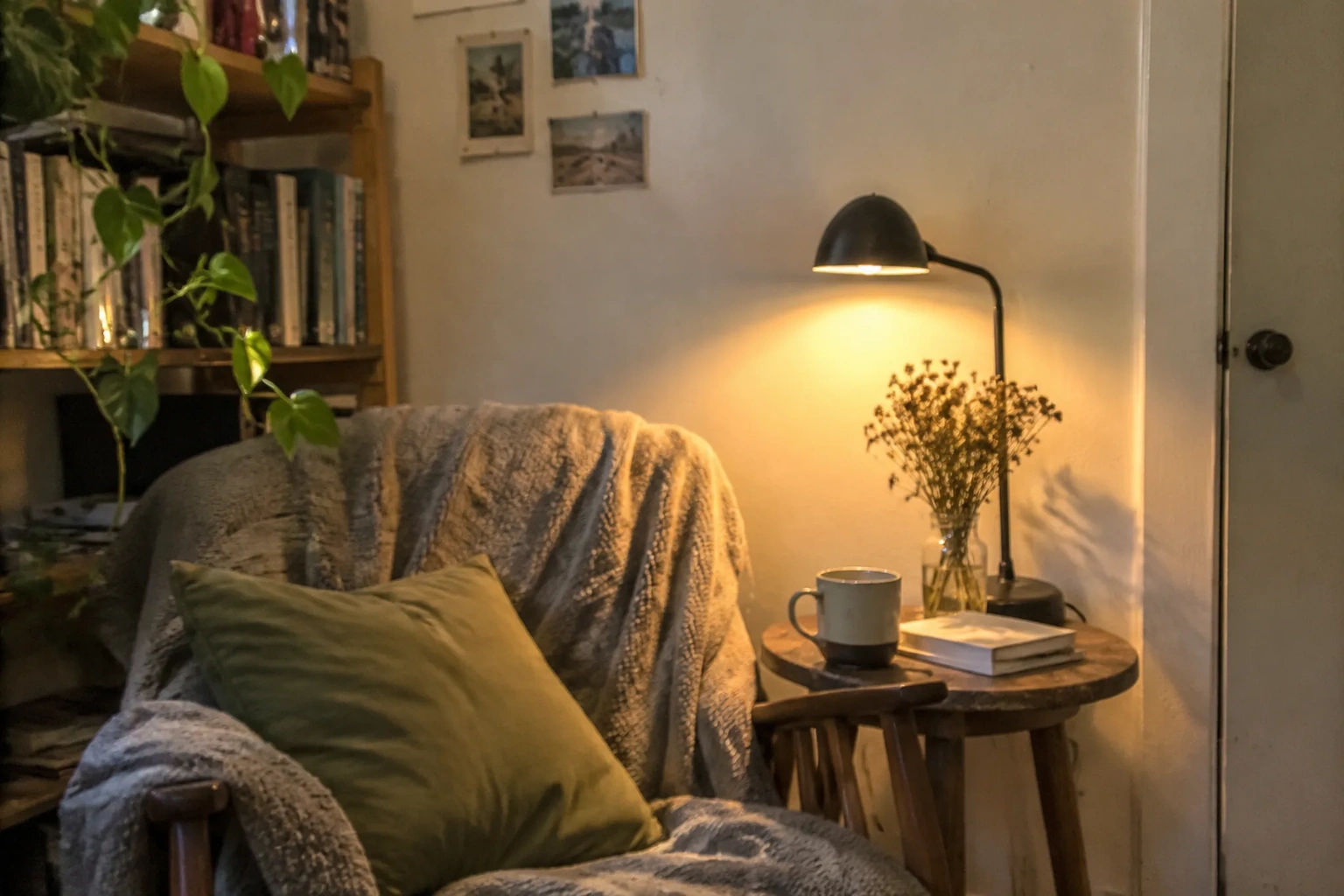
Eight square feet. That is roughly the floor space of a single armchair pushed into a corner, and it is enough to build a genuine refuge if the person setting it up stops treating the project as a shopping problem. The home office alcove, the strip of bedroom beside the radiator, the landing at the top of the stairs: these are the places where calm gets made, and none of them requires an architect, a budget approval, or a weekend lost to flat-pack furniture.
The mistake that sinks most attempts is scale. A small corner fails when it is asked to hold a full room's worth of functions: desk, display shelf, reading chair, plant collection, charging station, mood lighting. Eight square feet will not absorb all of that. It will hold one clear purpose and a supporting cast of three or four objects, and the discipline of choosing that purpose is the actual work.
The purpose gets named before anything gets bought
Calm corners serve one activity. Reading. Writing by hand. Morning coffee alone. A short breathing practice before the commute. The purpose can be modest, but it has to be singular, because a corner asked to do two jobs becomes a corner that does neither well and slowly fills with the residue of both.
A test that costs nothing: sit in the intended spot on the floor for ten minutes with no phone. Notice what the body wants. If the back wants support, the corner is a sitting corner and the seating decision is settled. If the hands want something to hold, it is a making corner. If the eyes keep drifting to a window, the window is the feature and everything else should defer to it.
Ten minutes on the floor sounds like a small thing. It prevents the most common and most expensive error, which is buying a beautiful object that fits the fantasy of the corner rather than the body that will actually use it.
Chairs that fit a corner rather than a catalog
Most chairs sold for reading are too big for a corner. A wingback with full arms eats thirty inches of depth and then demands clearance behind it, which pushes it into the middle of the floor and defeats the whole project. The chairs that work in tight spaces tend to be narrower, lighter, and often older: a wooden armchair with a thin cushion, a small slipper chair, a folding stool that tucks under a shelf when not in use.
Upholstery matters less than the seat height. A seat around seventeen or eighteen inches off the floor lets most adults sit with feet flat and knees at roughly a right angle, which is the difference between a chair that gets used for twenty minutes and one that gets used for an hour. Test this sitting down, not by reading the spec sheet.
If the corner is only ever used for short pauses, a floor cushion against the wall does the job and disappears entirely when the space needs to be something else. That flexibility is worth more than the dignity of furniture.
Light decides whether the corner gets used at all
A corner with bad light is a corner nobody visits, no matter how carefully it is styled. The lighting question comes before the furniture question, and it has two parts: daylight during the day, and a single small lamp for the evening.
Daylight is usually already there and simply needs to be unblocked. Curtains pulled back, a mirror angled to bounce light off a pale wall, a sheer panel instead of a heavy drape: these moves cost nothing and change the character of the space more than any purchase.
For the evening, one warm bulb in a small shade beats overhead lighting every time. Overhead light flattens a corner and makes it feel like a waiting area. A lamp at roughly eye level when seated, throwing light down onto a book or a page, creates the pool of warmth that people mean when they say a space feels calm. A bulb around 2700 kelvin is warm without being orange. Anything above 3000 starts to read as office.
The floor is half the room
In a space this small, the floor is not a backdrop. It is the largest single surface the eye registers, and it sets the temperature of the whole corner. Bare boards under a chair feel provisional and cold. A rug, even a modest one, marks the boundary of the corner and tells the body that this is a distinct place inside a larger room.
The rug does not need to be large, but it should be big enough that all four chair legs sit on it, or at least the front two. A rug that only catches the back legs is worse than no rug, because the chair rocks and the corner feels improvised. A thick wool or cotton flatweave in a muted color will outlast three trend cycles and is easy to shake out.
Bare feet on a rug versus bare feet on a cold floor is not a small difference. It is the difference between a corner a person lingers in and one they pass through.
Walls do more work than shelves
Floor space is scarce, so the walls should carry the storage. A narrow shelf mounted at shoulder height holds the books, the mug, the small speaker, and leaves the floor clear. Floating shelves are cheap, take an afternoon to install, and cost the corner nothing in square footage.
There is a discipline to wall storage in a small corner: everything on the shelf should be something the person actually reaches for while sitting there. A shelf of decorative objects that are never touched is a shelf of visual noise. Two books, a notebook, a pen cup, a candle, and one object worth looking at is enough. The empty space between objects is part of the design.
Art on the wall directly in front of the seat matters more than people expect. A corner facing a blank wall gives the eye nowhere to rest, and the body reads that blankness as unfinished. A single framed print at eye level when seated solves it for the price of a frame.
Sound is the forgotten material
Calm is as much an acoustic experience as a visual one, and corners in apartments are usually close to the noisiest parts of the home: the hallway, the kitchen, the street-facing window. Soft surfaces absorb sound. The rug, the upholstered chair, a curtain, a cushion, even a cork board on the wall each take a little of the edge off the room's echo.
A small corner does not need soundproofing. It needs enough soft material that the space stops sounding like a stairwell. A person can test this by clapping once while standing in the corner. A sharp, ringing slap means more fabric is needed. A muted thud means the space is already forgiving.
For steady background noise, a small fan or a white noise machine on the shelf does more for concentration than most people give it credit for, particularly in homes where silence is never actually silent.
What gets kept out of the corner
The corner's enemy is not clutter in the abstract. It is specific categories of object that migrate into any available floor space: laundry waiting to be folded, bags and coats, chargers and cables, paper that has not yet been filed or thrown away. Each of these has a home elsewhere, and the corner works only if they stay there.
A single small lidded basket beside the chair can hold the one or two things that legitimately belong to the corner, such as a throw blanket or a pair of reading glasses. The lid matters. An open basket becomes a magnet for everything within arm's reach.
The harder rule is that the corner holds no horizontal surface large enough to become a dumping ground. A tiny side table, no wider than a dinner plate, holds a mug and nothing else. Anything bigger invites the slow accumulation that turns a calm corner into a storage unit within a month.
The corner that changes with the day
The real advantage of a small space is that it can be reconfigured in under a minute. A stool that tucks under a shelf, a floor cushion that goes into a cupboard, a folding tray table that leans against the wall: these pieces let the same eight square feet serve as a reading nook in the morning and a clear floor in the evening.
That mutability is not a compromise. It is the specific pleasure of a small corner done well. The space does not demand permanence, and it does not ask the rest of the room to reorganize around it. It appears when needed and recedes when not.
Eight square feet, a chair that fits, one warm lamp, a rug that reaches all four legs, a shelf at shoulder height, and the discipline to keep the laundry out. That is the whole list. The people who build these corners successfully are not the ones with the largest budgets or the best taste. They are the ones who sat on the floor for ten minutes first and let the body, rather than the catalog, decide what went in.





















